Home / News / Industry news / How to Set Up Custom Polyurethane Foam Production: Equipment, Process & Cost Tips
How to Set Up Custom Polyurethane Foam Production: Equipment, Process & Cost Tips
Industry news-
Imagine a customer asking for a foam component that must hold a consistent density of 80 kg/m³ across a 20 mm wall, form a closed surface skin, and fit into a 90-second cycle. The chemistry can do it. The real question is whether your equipment, material delivery, and line layout can hold the same ratio and shot weight every cycle. Custom PU foam production should be treated as a system problem: the injection machine, premix approach, mold handling, and quality checks must be designed together rather than assembled piece by piece.
Start with the Product: Density, Shape, and Volume
Before selecting a machine, define the physical target of the part. This means choosing between flexible, semi-rigid, and rigid foam, and deciding whether molding or fabricated cutting is the better route. These choices determine the material family, the blowing agent, and the production line needed for reliable output.
Molded vs. Fabricated Foam
Fabricated foam starts from large blocks and is cut to shape. It is useful for low volumes, simple geometries, and quick prototypes. Molded foam uses a cavity that matches the final part, giving better dimensional control and lower labor in repeat production. For most custom PU foam production with medium to high volumes, molded foam is the more consistent route.
Flexible, Semi-Rigid, or Rigid
The mechanical requirement usually decides the foam family. Flexible foam absorbs energy and returns to shape, making it common in seating and packaging. Semi-rigid foam resists compression and appears in armrests and protective inserts. Rigid foam provides insulation and structural strength. Each family has a different target density range and processing window, so it is wise to fix this specification before discussing equipment.
High-Pressure Injection: Where Recipe Precision Meets Production Speed
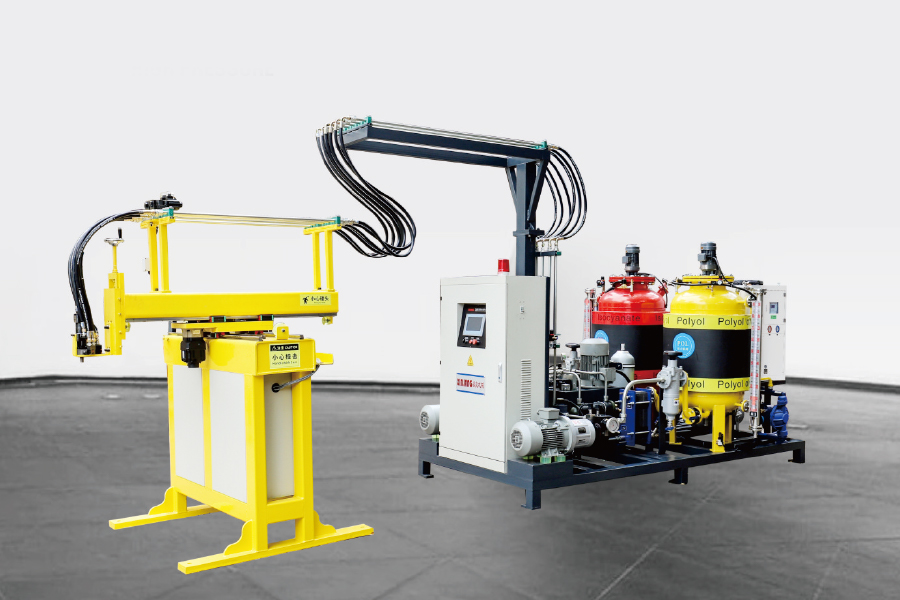
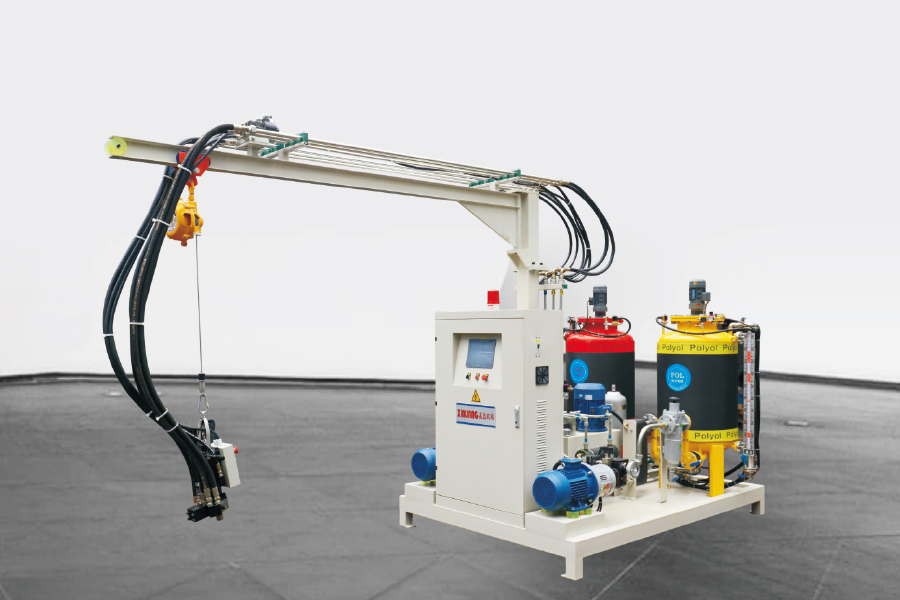
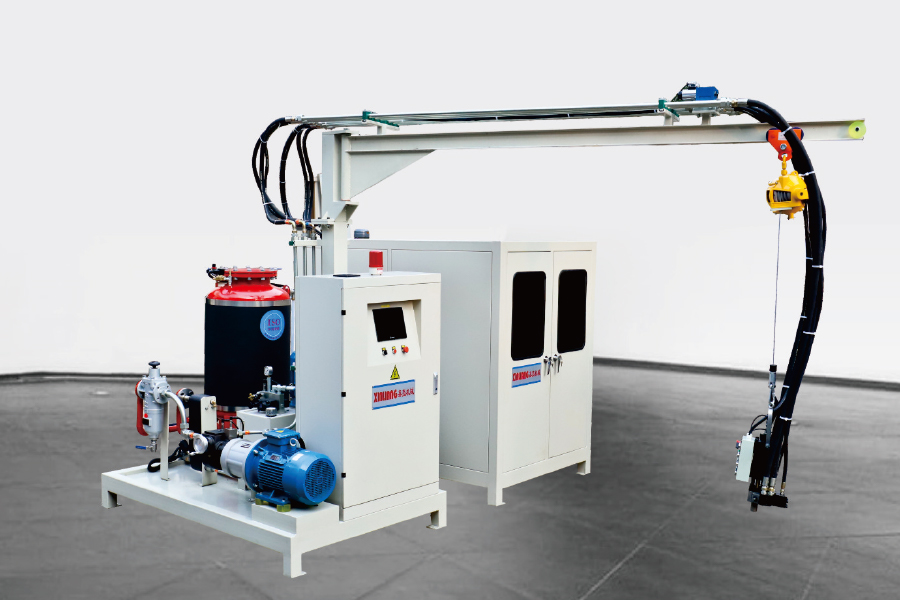
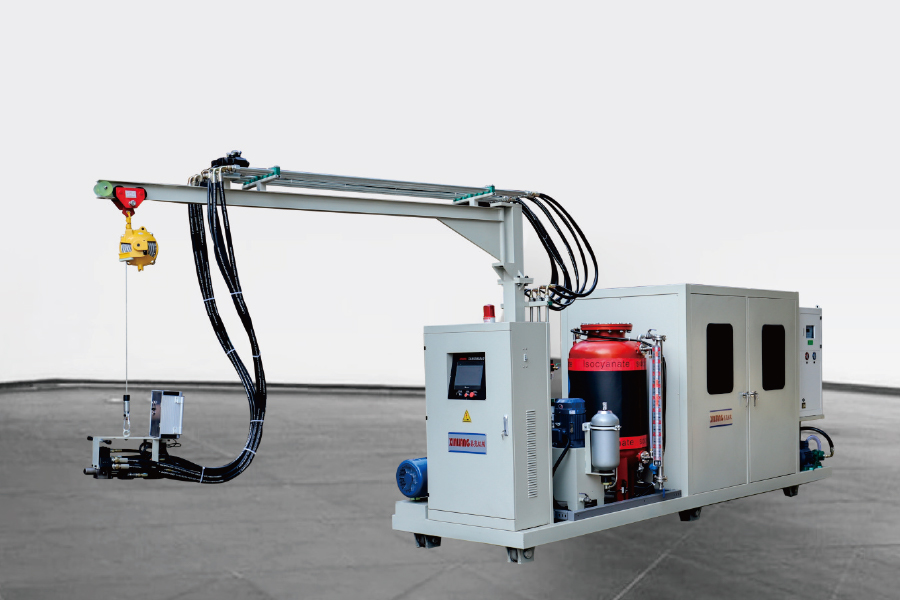
For repeatable custom PU foam production, the high-pressure injection machine is the central element. It impinges polyol and isocyanate in a small mixing chamber, creating a fine dispersion that reacts quickly. Shot weight is controlled by metering pumps, so the component ratio stays within a narrow tolerance from shot to shot.
Two-Component or Three-Component Metering
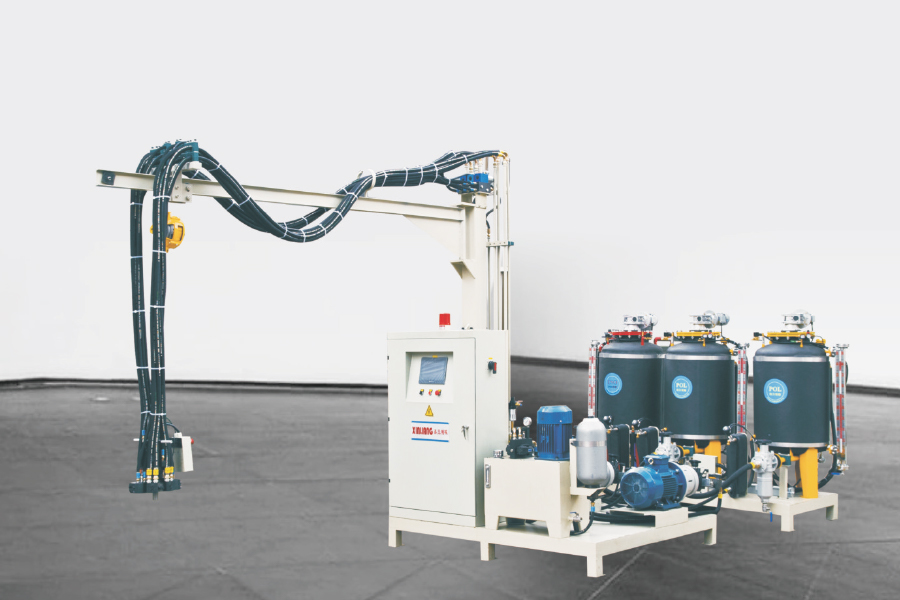
Two-component machines handle polyol and isocyanate, which is enough for many simple formulations. When the formula includes a third stream such as a flame retardant, color paste, or second resin, a three-component unit avoids manual preblending and reduces variation. A three-component high-pressure foaming injection machine is a practical choice when you need stable multistream addition.
High-pressure machines use self-cleaning mixing heads, which prevent cured material from affecting the next shot. Still, mixing head size, shot range, and component viscosity limits should be checked against the actual formulation. To understand how each module fits together, it helps to review the main components of a polyurethane foam production line before discussing custom modifications.
Many custom PU foam products for insulation, refrigeration, and building panels use cyclopentane as a blowing agent. It has zero ozone-depleting potential and low global warming potential compared with older HFC or HCFC systems. Because cyclopentane is flammable, the production environment and premix equipment must be designed for safety from the start.
Why a Premix System Makes Sense
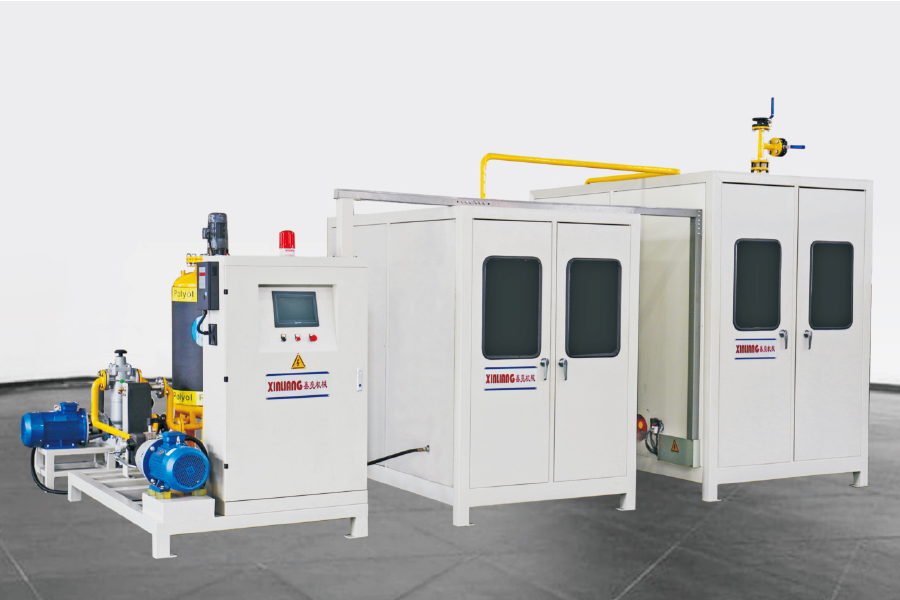
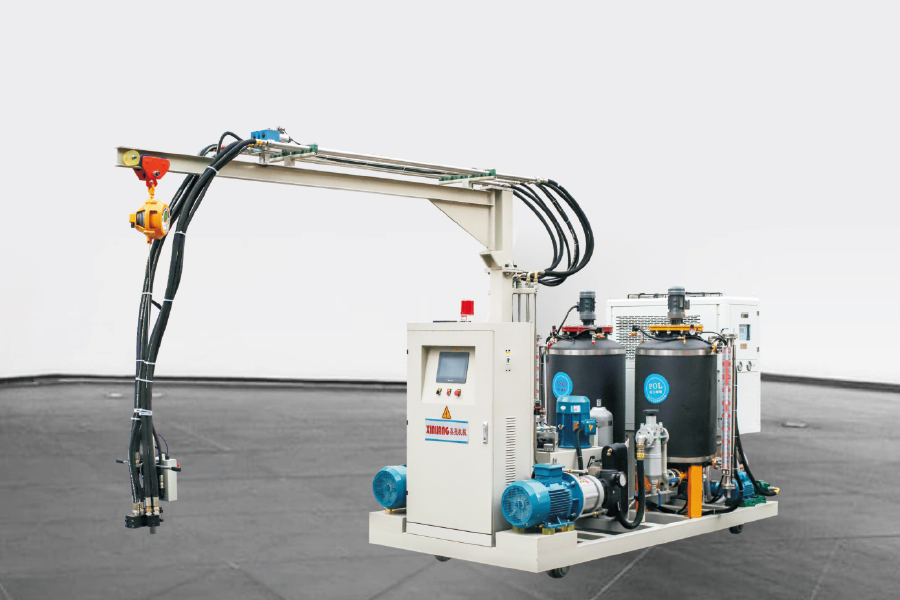
Direct injection of cyclopentane is possible, but a premix system blends the blowing agent into the polyol under controlled pressure and temperature before it reaches the mixing head. This improves homogeneity and avoids dosing errors. It also simplifies the injection machine layout, because the line then handles only two or three stable component streams. A correctly sized cyclopentane premix system allows you to keep formulation consistency while maintaining a safer operating envelope.
Not every seal, hose, or metering pump is compatible with cyclopentane. In a custom setup, specify that all wetted parts are rated for the blowing agent and that the tank and premix area include gas detection and ventilation. If you are still evaluating machine options, you can compare the key selection points in this guide to choosing the right cyclopentane polyurethane foaming injection machine.
Turntable, H-Type, or Annular: Matching Layout to Volume and Mold Size
Once the machine and material are defined, the next major decision is how molds move through the injection station. The line layout determines cycle time, labor requirement, and floor-space efficiency.
Key Layout Options
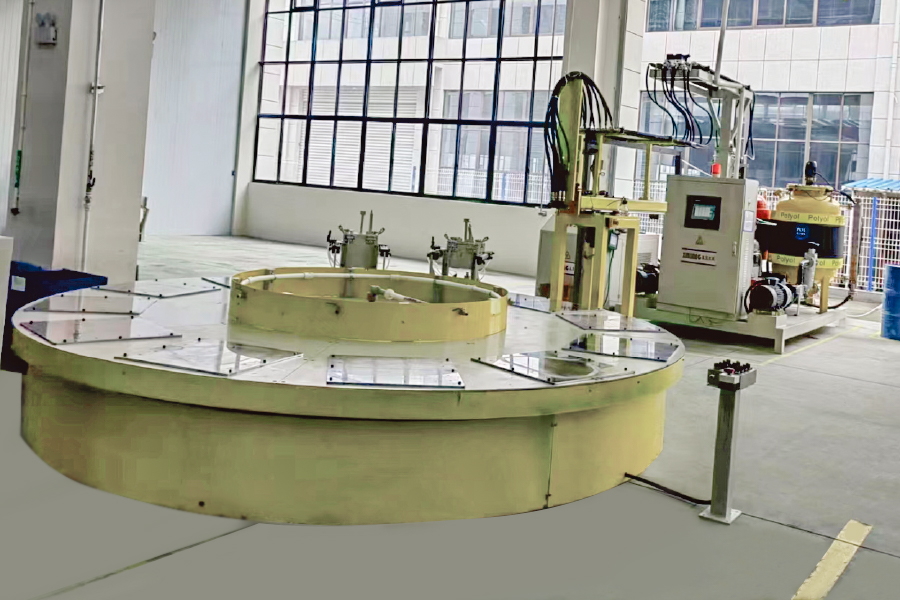
An annular or ring conveyor handles very high output with many mold carriers. An H-type line provides a straight, double-sided work area that gives flexibility for large or irregular parts. A turntable line organizes molds on a rotating platform, allowing one injection head to serve several stations with a small footprint. Many manufacturers with medium-to-high output choose a turntable foam injection machine production line because it balances cycle time, automation, and floor-space efficiency.
The isometric diagram below shows a typical turntable layout. Molds are indexed around the rotary table while the injection head remains at the filling station; operators or robots can perform finishing and demolding on the opposite side.
Comparing Line Characteristics
The radar chart below compares turntable, H-type, and annular layouts on five practical criteria. Ratings are illustrative and should be re-scored for your specific mold sizes and production targets.
Controlling Quality and Waste in Custom PU Foam Production
Quality problems usually show up as density variation, surface voids, or poor cell structure. Three checks matter most: material temperature, ratio accuracy, and shot weight. A deviation of only a few grams in a one-kilogram shot can shift density by several kilograms per cubic meter, so the metering system and its calibration deserve steady attention.
Density Ranges That Influence Process Design
Approximate density targets for the main foam groups are shown below. Treat these as general guidance rather than final specifications, because the actual range depends on the raw material system and part geometry.
Waste Reduction and the Cost Curve
Every defective shot costs material, cleaning time, and production capacity. Stabilizing the metering system reduces waste, and automated lines improve reproducibility. The chart below illustrates how unit cost typically falls as volume rises, especially when an automated turntable line replaces a single-machine setup.
For practical steps on reducing scrap, read how to reduce material waste by 30% in PU foam processing. The biggest gains usually come from stable metering and better operator discipline, not from changing the formulation.
What to Check Before You Order a Custom PU Foam Production Setup
A custom setup is more than the injection machine. It includes the premix station, line layout, control system, and safety equipment. Before ordering, define the production output, mold sizes, material system, and local safety requirements. The comparison below is a simple starting point, not a substitute for a process trial.
Illustrative comparison of process options; actual values depend on mold design and formulation.
Production Approach
Typical Output
Consistency
Automation Level
Single high-pressure machine with manual mold carrying
Low to medium
Good per shot, operator-dependent
Low to medium
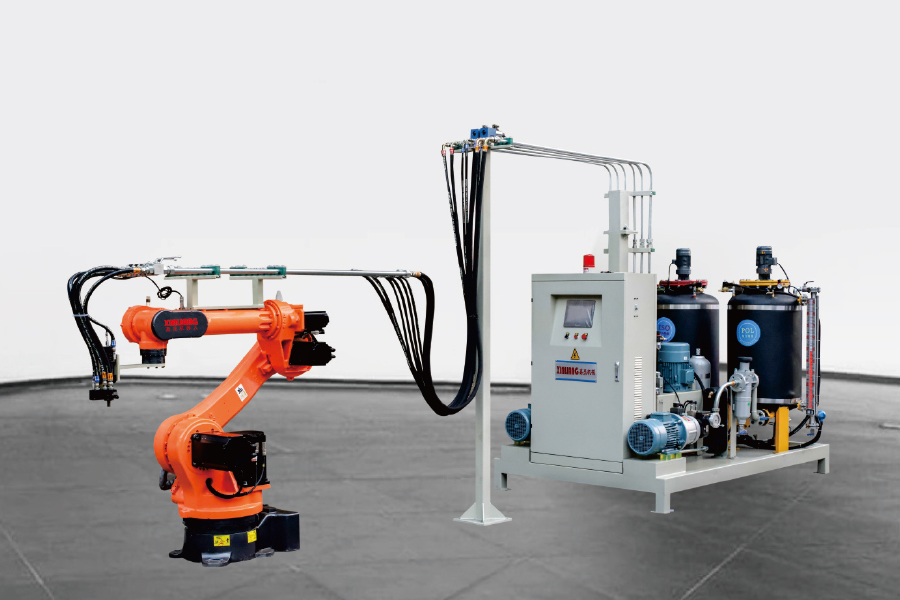
Machine with XY-axis manipulator
Medium
Very good
Medium
Turntable foam injection line
High
Excellent
High
Also check that the supplier can run a test with your actual material and molds. Machine ratio accuracy, mixing quality, cleaning access, and safety features for flammable blowing agents are more important than the maximum pump capacity on the datasheet.
Frequently Asked Questions About Custom PU Foam Production
Q1: What density ranges can custom PU foam production achieve?
With standard metering and mixing equipment, foam density can be adjusted over a wide range. Rigid insulation foams often start around 25–70 kg/m³, while integral skin foams can reach 700 kg/m³ or more. The exact range depends on the polyol, isocyanate, and blowing agent formulation.
Q2: How do I choose between a two-component and three-component injection machine?
If your formula requires a third stream, such as a flame retardant, color paste, or an extra resin tank, a three-component machine gives independent ratio control and avoids manual premixing errors.
Q3: Why use cyclopentane as a blowing agent?
Cyclopentane has zero ozone-depleting potential and low global warming potential, and it works well in rigid and semi-rigid foams. A premix system keeps the blowing agent properly blended with polyol before injection, which stabilizes density and thermal performance.
Q4: What should I check before buying a custom PU foam production line?
Look for verified throughput, ratio accuracy, mixing quality, easy cleaning, safety features for flammable blowing agents, and the manufacturer's ability to support process commissioning and spare-part supply.


 English
 русский
 عربى
عربى