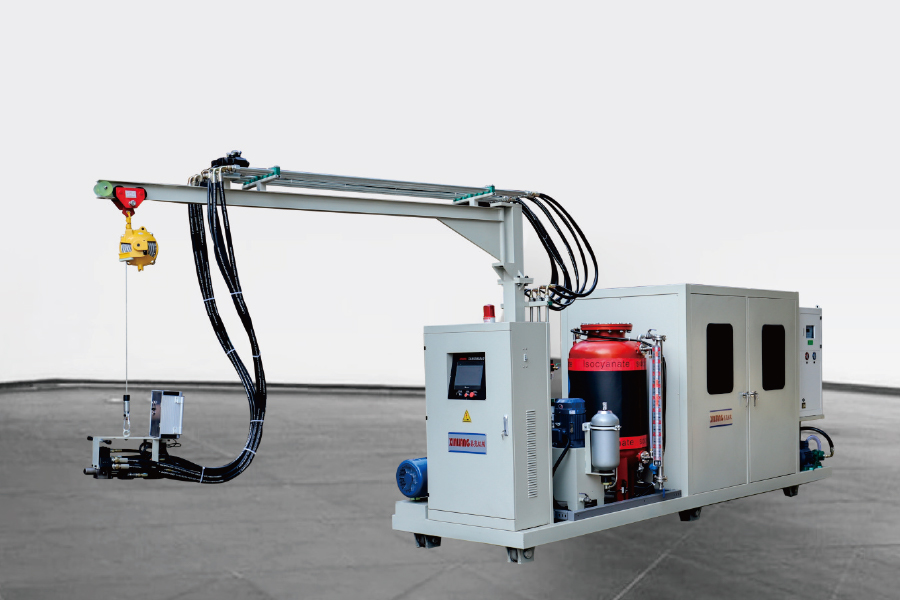
Polyurethane foam is manufactured by metering, mixing, and dispensing two liquid chemical streams — an isocyanate and a polyol blend — and then letting the reacting mixture expand into a solid, cellular plastic. The visible expansion takes seconds; the internal chemistry keeps building strength for hours. Everything that matters in the finished part, including density, cell structure, insulation value, and load-bearing capacity, is largely decided in the first moments after the two streams collide in the mixing head.
Most people know the result, not the process: the rigid insulation layer inside a refrigerator door, the flexible cushioning under a car seat, the continuous board on a building roof. All of them follow the same sequence: raw material preparation, accurate metering, high-pressure mixing, dispensing into a mold or onto a conveyor, expansion, and curing.
The Chemistry: Isocyanate, Polyol, and the Gas That Builds Cells
Polyurethane foam forms when an isocyanate reacts with a polyol. The isocyanate's -NCO group attacks the polyol's -OH group to form a urethane bond, joining short liquid molecules into a long solid polymer. The reaction releases heat, and that exothermic heat expands the gas that creates the foam's cellular structure.
Two gas-generating routes run in parallel in most formulations:
Chemical blowing: water reacts with isocyanate to release carbon dioxide gas.
Physical blowing: a low-boiling liquid — most commonly cyclopentane in modern rigid foam — evaporates as the mixture warms up.
Catalysts control the balance between the gelling reaction and the blowing reaction, while silicone surfactants stabilize growing cells so they do not collapse under their own weight. Change the ratio of any of these components and the foam shifts from soft and flexible to rigid and structural.
Raw Materials: What Actually Goes Into the Mix
A typical rigid polyurethane foam formulation, expressed in parts per 100 parts of polyol, looks like this:
Typical rigid polyurethane foam formulation, in parts by weight per 100 parts of polyol.
Raw material
Function in the reaction
Typical parts
Polyol (polyether)
Polymer backbone; defines flexibility
100
Isocyanate (MDI)
Crosslinks the polymer; builds strength
40–60
Cyclopentane
Physical blowing agent; creates the cells
10–15
Water
Chemical blowing agent; releases CO2
2–4
Silicone surfactant
Stabilizes cells during the rise
1–2
Amine / tin catalysts
Balance gelling and blowing speed
0.5–2
The chart makes a point that matters on the production floor: the isocyanate content is only 40–60 percent of the polyol content by weight, yet a metering error of just 1–2 percent in either stream changes cell structure, density, and adhesion. That is why high-pressure dosing pumps, rather than the mixing paddle, are the real heart of a foam line.
Cyclopentane deserves special attention for appliance and panel foam. It replaced freon-type blowing agents because it has near-zero ozone-depletion potential, but it is flammable. Plants therefore blend it into the polyol either on a safe premix skid or through a continuous cyclopentane premix system. The delivery route for the blowing agent is one of the first decisions an appliance foam producer faces; our guide to how to choose the right cyclopentane polyurethane foaming injection machine explains the main options.
Step by Step: How Polyurethane Foam Is Manufactured
1. Raw Material Conditioning
Both components are stored in temperature-controlled tanks and continuously recirculated to keep them uniform. Temperature directly affects viscosity and reactivity: most MDI-based systems are held between 20 and 35 °C. The polyol tank usually already contains the surfactants, catalysts, water, and, when a premix skid is used, the cyclopentane.
2. Accurate Metering
High-pressure pumps deliver each component to the mixing head at a controlled output and a controlled ratio. Modern machines state ratio accuracy at about ±0.5 to 1 percent by volume. If the isocyanate side drifts high, the foam becomes brittle and may scorch in thick sections; if it drifts low, cells collapse and the part lacks structural strength.
3. Impingement Mixing
High-pressure machines mix without a mechanical agitator. The two streams enter a small chamber at roughly 120–180 bar and collide head-on at high velocity. The impact does the mixing, and a hydraulic piston flushes the chamber after every shot so residue cannot cure inside the head.
4. Dispensing Into a Mold or Onto a Conveyor
The reacting liquid is injected into a closed mold, an open mold, or directly onto a conveyor. In molded parts, the injected amount — called the shot weight or packing factor — sets the final density. On continuous slabstock lines, the liquid is poured into a moving trough where it rises into a long block.
5. Rise, Gel, and Cure
Once the liquid is at rest, the chemistry takes over. The mixture creams, rises, gels, and becomes tack-free. The rise curve below is typical of a rigid free-rise foam: quick start, fast linear growth, then a plateau as the cells lock into place.
After the plateau, the foam is chemically solid but still warm and soft. Molded rigid parts are usually demolded within 5–15 minutes, and the part reaches close to its final strength after about 24 hours at room temperature.
6. Finishing and Post-Processing
Molded parts are trimmed of flash and checked for voids; slabstock blocks are cut into sheets; rigid panels are cut to size, edged, and laminated when required. Good housekeeping matters here because polyurethane dust and partially cured residue are the main contamination sources on a foam line.
Flexible, Rigid, Slabstock, and Molded: Process Variants
The chemistry is the same, but the recipe and the equipment change with the end product. Four variants cover most of the industry:
Flexible slabstock foam: a low-density, open-cell block foam for mattresses and upholstery. The mix is poured onto a wide conveyor, rises into a continuous bun, and is cut into sheets.
Flexible molded foam: used for automotive seats. The mix is injected into shaped molds, and the open-cell structure lets air pass through the cushion.
Rigid molded foam: a closed-cell, dimensionally stable foam for refrigerator cabinets and insulation boards. Cyclopentane blowing and high injection pressure keep the cells small and the insulation value high.
Rigid spray foam: the same chemistry applied on site with portable equipment for building insulation.
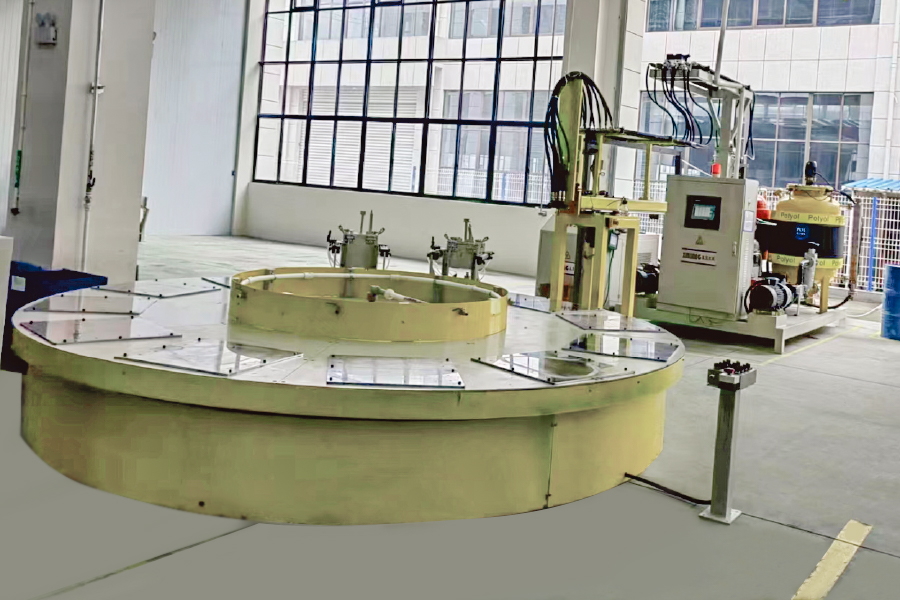
The production setup follows the product. For high-volume molded parts such as insulation boards, a turntable foam injection molding machine production line indexes molds through filling, curing, and demolding stations so the injection head never waits for a mold. For continuous rigid panels, an H-type or annular line is a better fit. Single-machine operation remains economical for small batches and custom parts.
Three pieces of equipment define a polyurethane foam plant: the injection machine, the premix or blending system, and the production line.
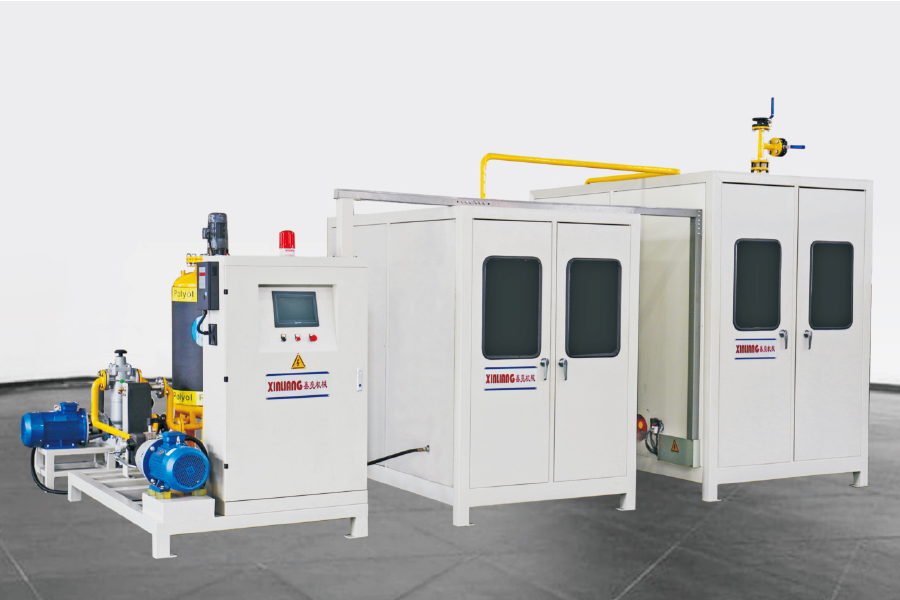
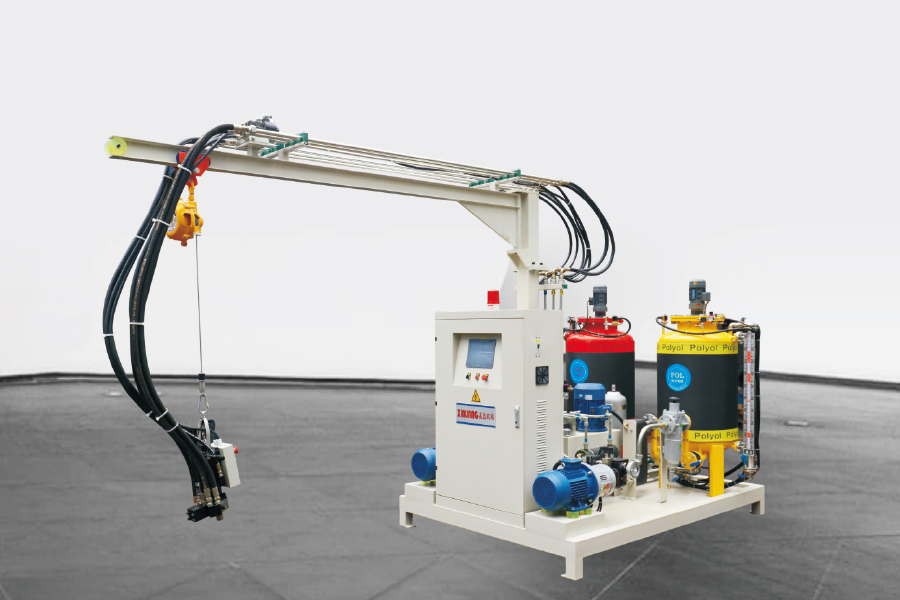
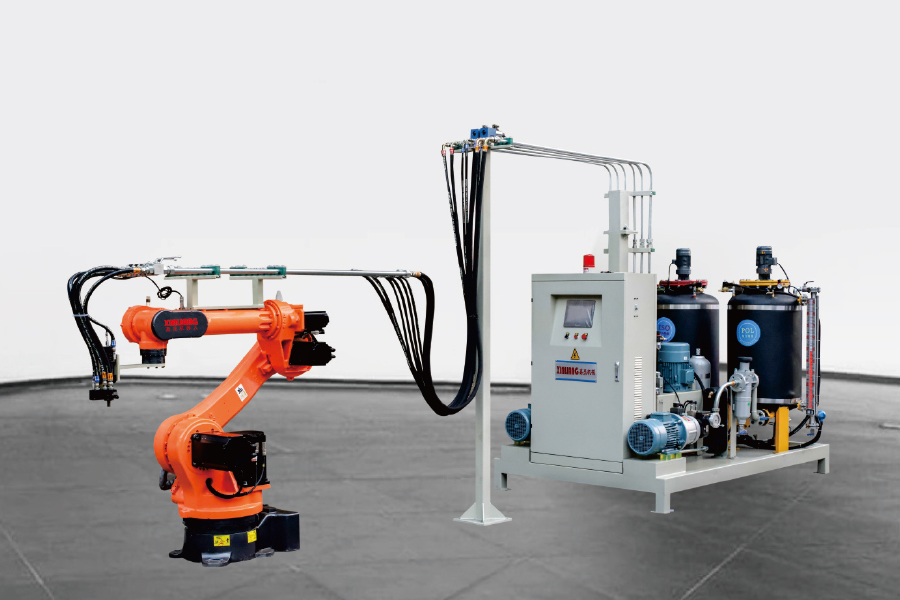
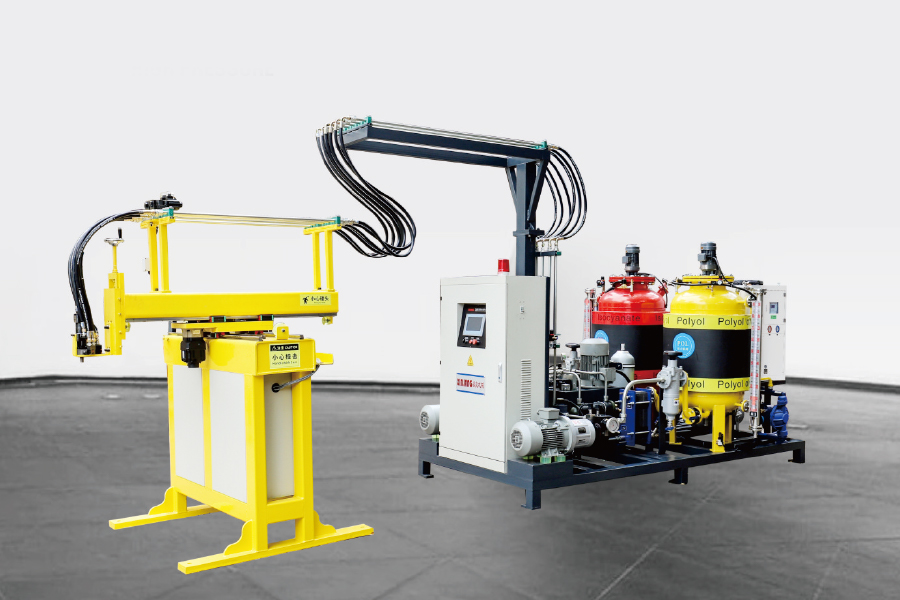
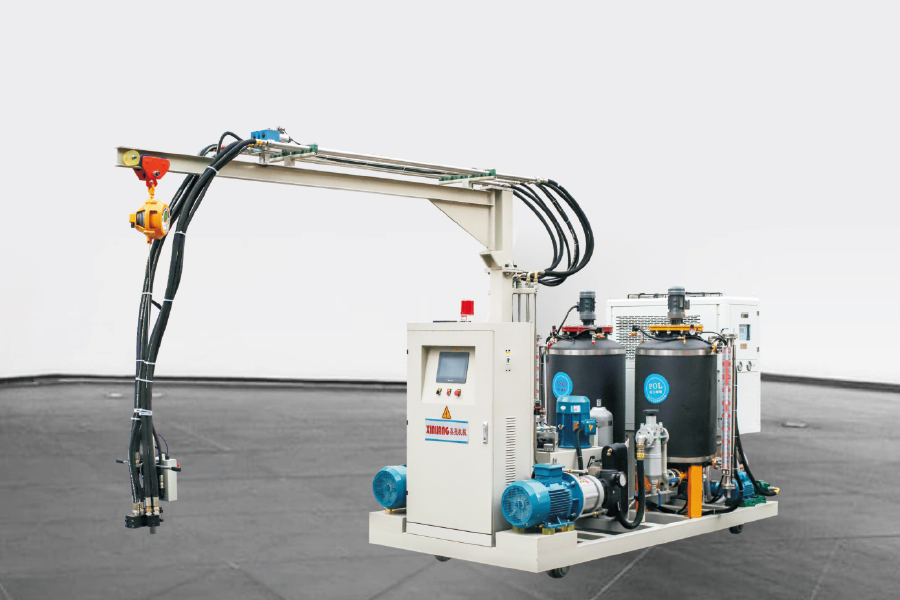
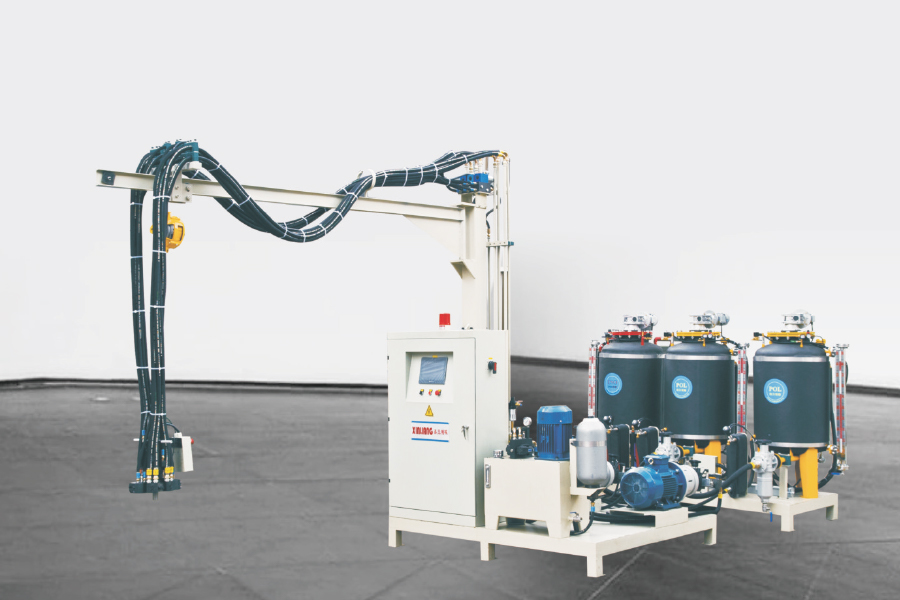
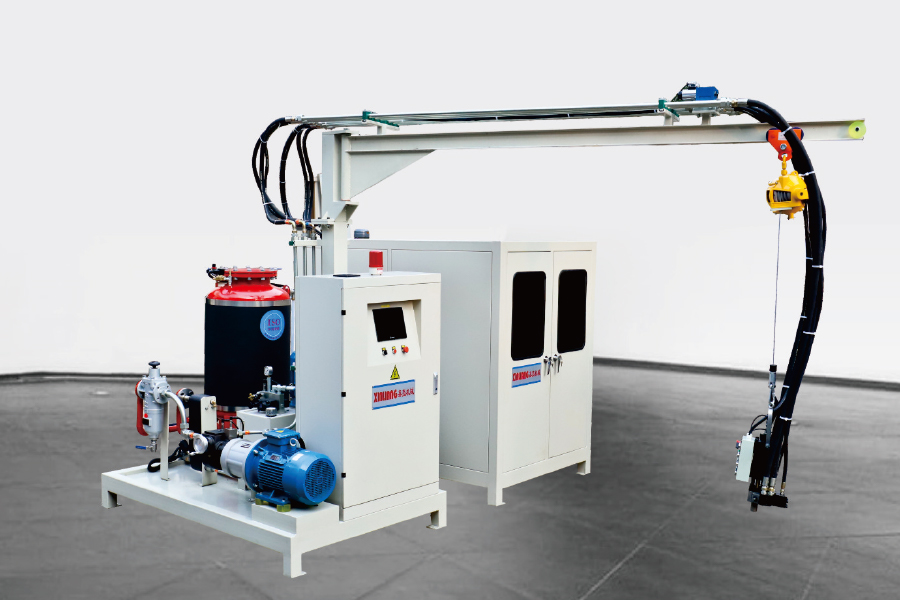
The injection machine meters and mixes the chemicals at high pressure. Two-component machines handle the large majority of applications; three-component machines add a third stream for flame retardants, colorants, or special polyol blends. Ningbo Xinliang Machinery's two-component polyurethane high-pressure foaming injection machine is a typical example of this class, with dosing accuracy and mixing pressure monitored on every shot. If you are new to the category, start with our explanation of what a polyurethane high-pressure foaming injection machine is.
The premix system takes the blowing agent and blends it into the polyol safely, so the injection machine always receives a uniform batch. The production line organizes the mold cycle: a turntable for many small molds in rotation, an H-type line for large rigid panels, or an annular line for continuous laminated boards. The right combination depends on part size, production volume, and the hourly output you need to hold.
What Decides Whether the Foam Meets Spec
Five variables separate a clean, uniformly risen foam from a rejected batch: ratio accuracy, component temperature, mixing pressure, mold temperature, and raw material consistency.
Temperature is the easiest variable to get wrong because it changes the cream time — the interval between injection and the start of expansion. The typical trend for an MDI system is shown below: as the component temperature rises, the cream time shortens almost linearly. Foam chemical suppliers typically quote cream times in the range of 4–12 seconds for cabinet systems, depending on formulation and process temperature.
Mixing pressure is the operator's early warning system: a pressure drop at the mix head usually means a worn nozzle, a fouled chamber, or a pump losing stroke. Ratio drift, contaminated raw material, and a moist polyol batch all show up in the cell structure before any laboratory test is finished. For a closer look at each variable, read our breakdown of what factors affect polyurethane foam injection quality.
Frequently Asked Questions About Polyurethane Foam Manufacturing
Q1. What is polyurethane foam made from?
Polyurethane foam is made from an isocyanate (usually MDI or TDI) and a polyol, plus water or a physical blowing agent, surfactants, and catalysts. The isocyanate reacts with the polyol to form the polymer, while the blowing agent creates the cells.
Q2. What is the difference between rigid and flexible polyurethane foam?
Rigid foam is closed-cell, dense, and dimensionally stable; it is used for thermal insulation in refrigerators and building panels. Flexible foam is open-cell and soft; it is used for mattresses, furniture, and vehicle seating.
Q3. What is cyclopentane used for in polyurethane foam?
Cyclopentane is the physical blowing agent in modern rigid foam. It evaporates inside the reacting mixture and expands the cells, giving refrigerator and panel foam high insulation value without the ozone-depleting gases used in older processes.
Q4. How long does polyurethane foam take to cure?
The visible rise finishes within about two minutes. Molded parts can be demolded in 5 to 15 minutes, but the polymer continues to crosslink, and full dimensional stability usually takes 24 hours or longer.
Q5. Can polyurethane foam be recycled?
Yes. Flexible foam scrap can be chopped and bonded into rebond carpet underlay. Rigid foam can be ground into filler or depolymerized through glycolysis to recover polyols for new foam.
Q6. What is a polyurethane high-pressure foaming machine?
It is a machine that meters two or more liquid components with high-pressure pumps, mixes them by impingement in a mixing head, and injects the reacting mixture into a mold or onto a conveyor, where it expands into foam.


 English
 русский
 عربى
عربى