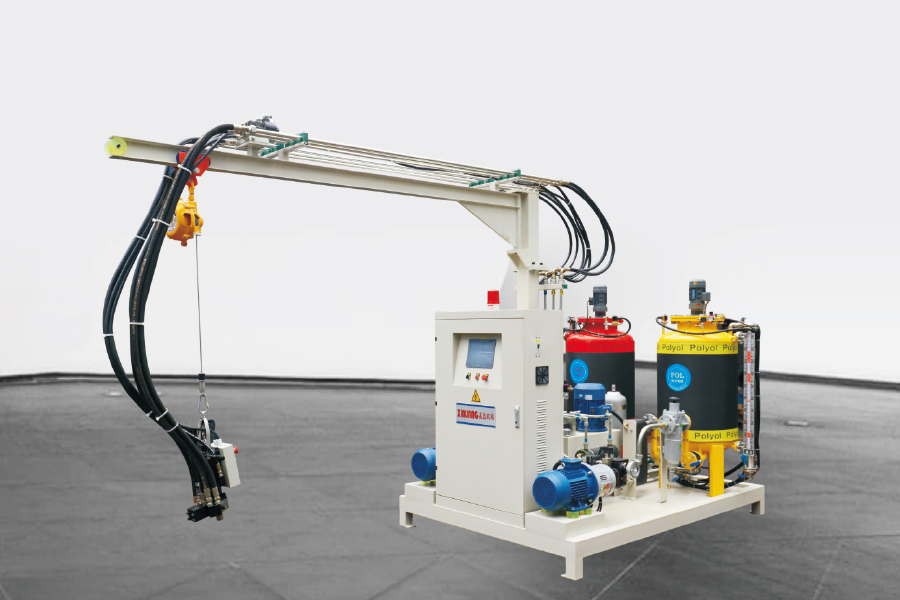
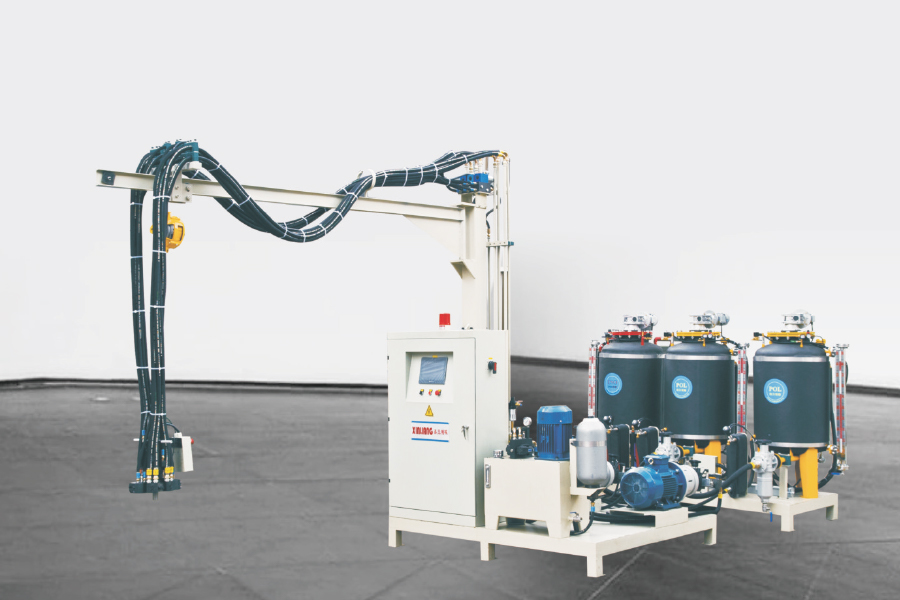
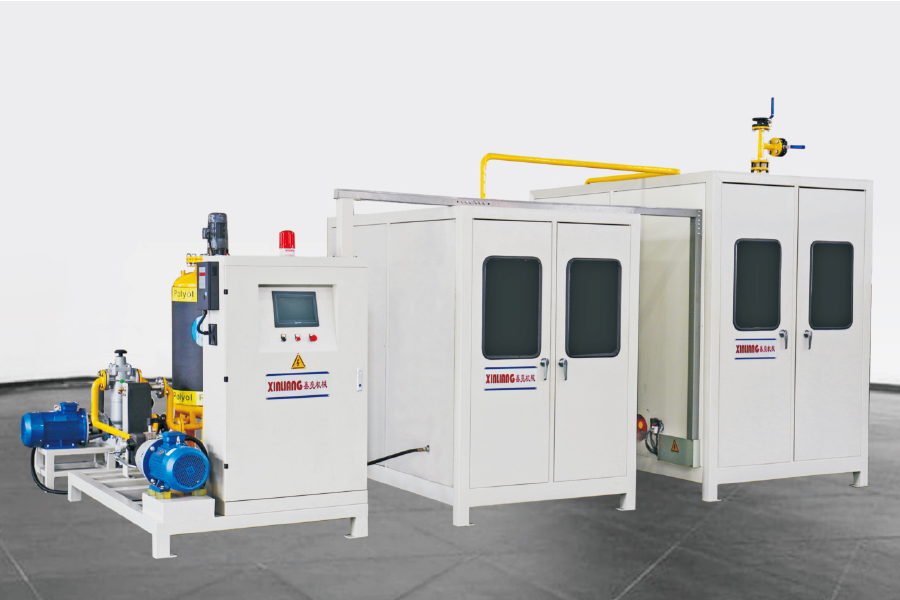
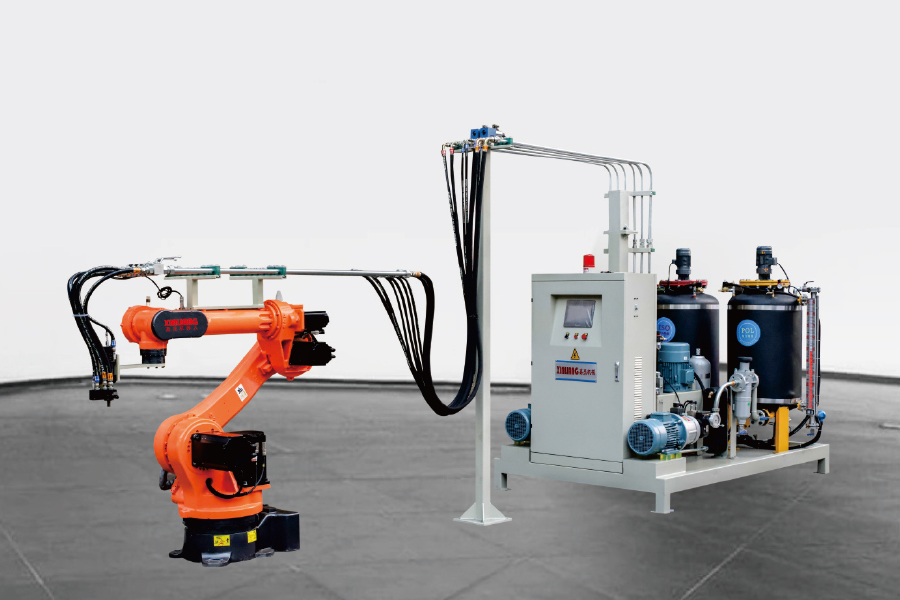
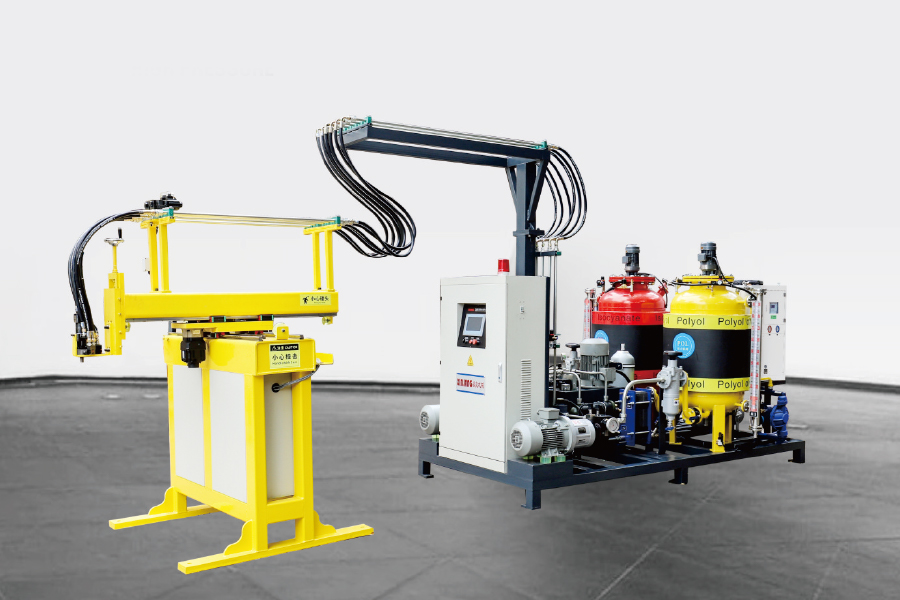
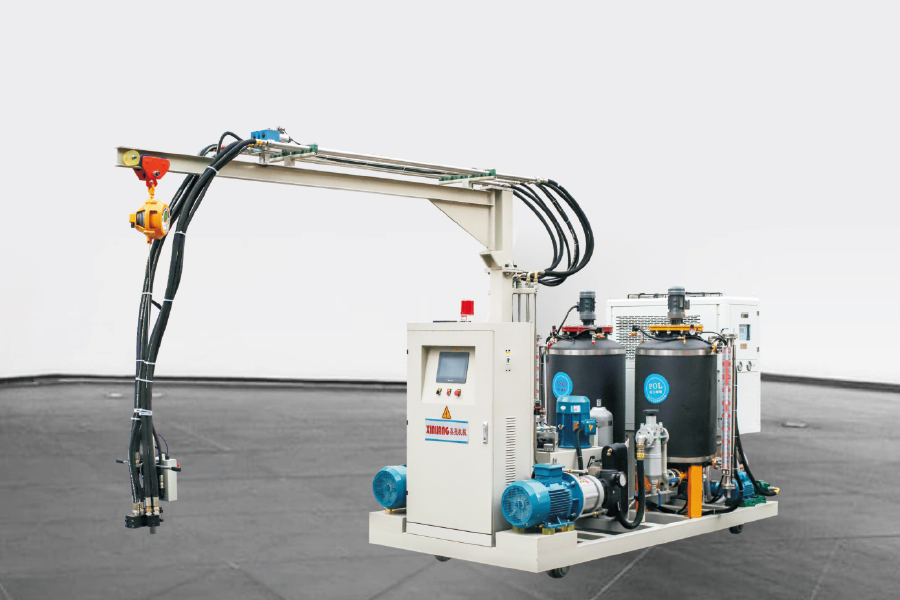
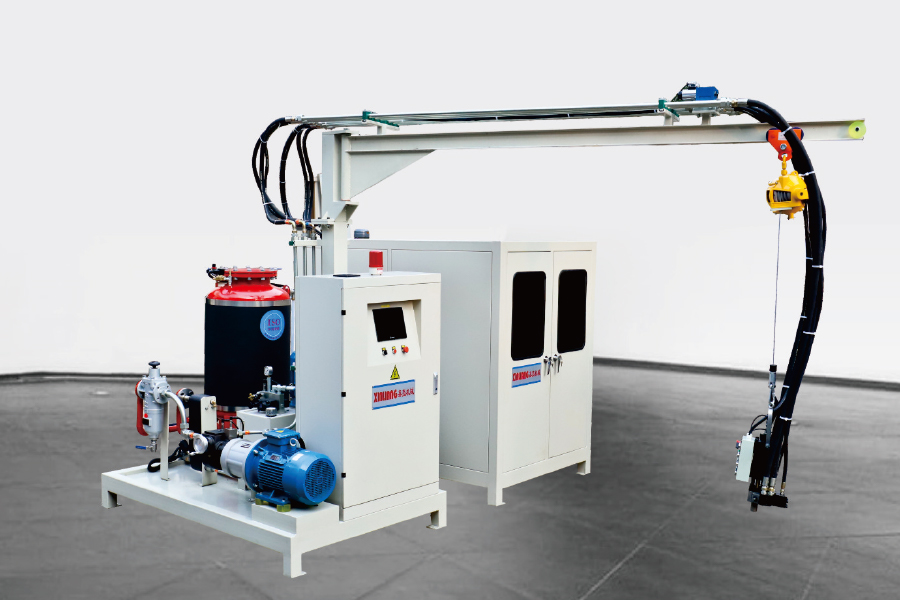
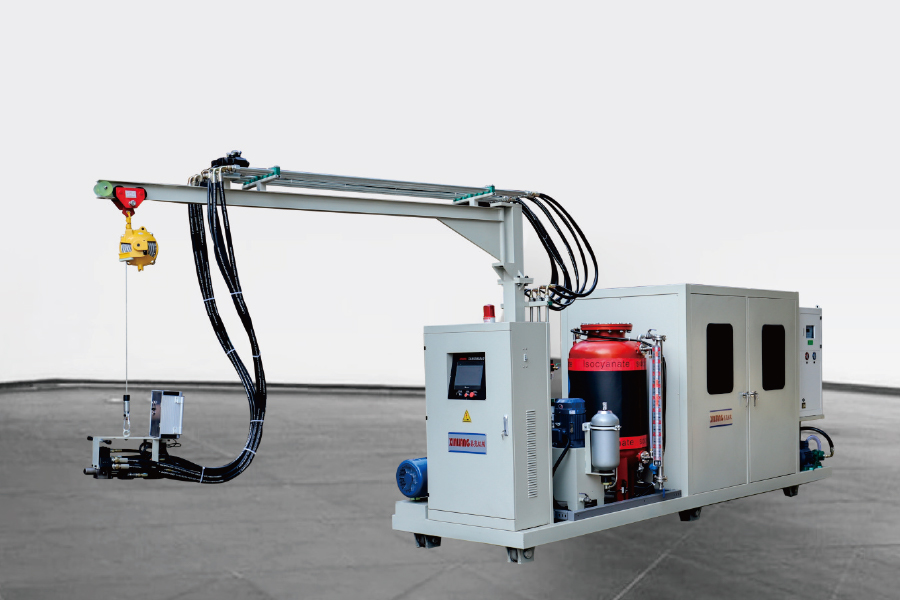
Walk onto a sandwich panel line and the press or the double belt gets all the attention. The money is usually saved or lost somewhere else: at the mixing head. Two lines fitted with identical forming hardware can run at very different scrap rates simply because one holds its polyol-to-isocyanate ratio stable and places an even shot, while the other drifts between shifts.
That is the conclusion up front, and it holds for both production routes — the continuous double-belt line that pours foam onto a moving facing, and the mould-based line where a track- or robot-mounted head injects a metered shot into a cavity. The rest of this guide breaks down what a polyurethane sandwich panel machine actually includes, where the foam equipment earns its keep, and which specifications are worth writing into a purchase order.
What a Polyurethane Sandwich Panel Machine Actually Includes
The phrase is used loosely. Some suppliers mean the complete line; buyers often mean only the foaming equipment. A working system normally has five blocks:
Metering unit — tanks, pumps, heat exchangers and flow meters that keep component ratio and temperature stable.
High-pressure mixing head — where the polyol and isocyanate streams meet and react.
Head positioning hardware — a fixed pour point, a track, an XY gantry or a six-axis robot.
Forming hardware — a double-belt conveyor with laminator and side seals, or mould carriers, presses and demoulding stations.
Controls and safety — recipe management, gas detection, ventilation and shutdown logic.
Continuous and discontinuous lines share this core but load it differently. On a continuous line the head is often fixed and the belt moves underneath it; output is measured in kilograms per minute, and ratio stability over hours of running matters more than single-shot accuracy. On a mould line the head travels, and the metric is grams per shot: a 1,200 × 2,400 mm panel with a 50 mm core at 40 kg/m³ needs roughly six kilograms of foam, placed evenly before the cream time expires.
Why the Injection System Sets Panel Quality
High-pressure machines collide the two streams at 100–200 bar inside a small mixing chamber, and the energy of that collision does the mixing. Low-pressure machines stir the components mechanically at roughly 5–20 bar and generally rely on nucleating air to create the cell structure.
Fig. 1: Commonly published operating pressure windows for the two mixing technologies.
According to panel standards such as EN 14509 and published equipment data, rigid PU panel cores are commonly specified between 30 and 50 kg/m³. Reaching the lower end of that band without voids depends on how fine and even the cell structure is, because coarse cells collapse under the pressure of the laminator and leave density variation across the panel width.
Fig. 2: Schematic comparison. Blue: high-pressure impingement mixing. Orange: low-pressure mechanical mixing. Values illustrate general equipment characteristics, not measured data.
The same logic applies to adhesion: impingement-mixed foam wets the facing skins more consistently, which reduces the risk of delamination during sawing or handling.
For mould-based panel production, a two-component high-pressure foaming injection machine with a track, an XY gantry or a robot-mounted head is the usual starting point. Fix the maximum shot weight, the ratio window and the traverse speed first; everything else on the line can be adapted around those three numbers.
Matching Injection Capacity to the Line
Sizing is a short exercise once the panel family is fixed. Multiply the largest panel volume by the target density to get the maximum shot weight, then multiply the panels per hour by that shot to get the continuous output in kilograms per minute. Two numbers buyers tend to forget: the ratio window the pumps must hold across the full output range, and the head positioning accuracy the mould layout demands.
Table 1: How continuous and discontinuous production shift the load onto the foam equipment.
Decision point
Continuous double-belt line
Discontinuous mould or carousel line
Typical batch size
Long runs, one panel family, high volume
Small to medium batches, frequent product changes
What the foam equipment must hold
Output in kg/min and ratio stability across hours of running
Shot weight accuracy and head positioning repeatability
Head movement
Fixed or traversing pour point, moving belt underneath
Track, XY gantry or six-axis robot
Blowing agent handling
Pentane or HFO with premix and safety systems on a larger scale
Same chemistry, smaller buffer volumes
Specify first
kg/min at target density, belt speed range, side seal design
Shot size range, number of moulds, cycle time
Where a third stream is needed — a colour paste, a catalyst package or a separate polyol for PIR formulations — a three-component machine adds an independent metering circuit instead of forcing the additive through the main line.
Bl owing agent choice reshapes the equipment more than most buyers expect. HFCs are being phased down under the Kigali Amendment to the Montreal Protocol, and panel producers have largely moved to cyclopentane, HFO blends or water-assisted systems. Cyclopentane is flammable and has a low boiling point, so it changes the machine specification: explosion-proof electrical equipment, nitrogen blanketing, ventilation, gas detection and a closed loop that never exposes the liquid to atmosphere.
The alternative to injecting pentane directly is to premix it with the polyol first. A premix system holds the blend at a controlled temperature and pressure, which stabilises the blowing agent concentration reaching the mixing head — the usual cause of density drift and surface defects on pentane-blown panels. It also reduces the free pentane released at the pour point, which matters for both safety and cost.
For lines already running pentane, a premix unit is often the cheapest way to tighten density variation before considering a new metering unit.
How a Discontinuous Panel Line Is Laid Out
On a mould-based line the sequence is fixed: the operator or robot places the lower facing, the carrier indexes under the mixing head, the head pours the shot while travelling across the cavity, the upper facing is placed and the mould closes, the press holds while the foam gels, and the panel is demoulded and trimmed. Cycle time is set by the chemistry, not the machine — but the machine decides whether that cycle can run at its theoretical minimum.
Fig. 3: Isometric view of the foaming side of a mould-based panel line.
Two details in that layout drive cycle time. The first is the distance the head must travel while the foam is still liquid; a slow traverse forces either a shorter cavity or a longer cream time. The second is mould temperature, which is why panel lines usually tie the mould circuit into the same control system as the metering unit.
A Short Buying Checklist
Before you sign, put these seven points in writing:
Maximum shot weight in grams and continuous output in kilograms per minute, both quoted at your target density.
Ratio range and repeatability across the full output range, not only at full speed.
Blowing agent compatibility, including explosion-proof classification if pentane is involved.
Head type and positioning: fixed pour, track, XY gantry or six-axis robot, with traverse speed specified.
Mould or carrier count, opening stroke and clamping force the machine has to synchronise with.
Spare parts list and response time for mixing chambers, seals, pumps and flow meters.
Acceptance test: run your density and thickness on the machine before shipment, and record the shot weight spread.
As a Ningbo-based polyurethane foaming equipment manufacturer working on metering units, mixing heads and production lines, we see the same pattern in most enquiries: the forming hardware is specified in detail, while the foam side is left to the last minute. It is the wrong way round.
Frequently Asked Questions
Q1. What is a polyurethane sandwich panel machine, and what drives its price?
It is a system rather than a single unit: metering unit, mixing head, head positioning and forming hardware. Price depends mainly on continuous versus mould-based production, output and automation level, so ask for a quotation against your panel thickness, density and hourly output.
Q2. What is the difference between PU and PIR sandwich panels?
Both use polyurethane chemistry. PIR foam is formulated at a higher isocyanate index, which improves fire behaviour but makes ratio control more critical, and it often benefits from a third metering stream for additives.
Q3. Can one high-pressure foaming machine serve both continuous and mould lines?
The metering unit can, the mixing head usually cannot. Continuous lines need high, steady output with a fixed or traversing pour, while mould lines need precise shot weights and a head mounted on a track, gantry or robot.
Q4. Which blowing agent is used for polyurethane panel foam today?
HFCs are being phased down under the Kigali Amendment, so most producers have moved to cyclopentane, HFO blends or water-assisted systems. Cyclopentane is flammable, so premix systems, explosion-proof wiring and ventilation become part of the machine specification.
Q5. How long is the cycle time on a discontinuous sandwich panel line?
Cream, gel and cure times in the formulation set it, not the machine. The machine's job is to keep shot weight and mould temperature constant so the cycle does not have to be padded for safety.
Q6. How can a sandwich panel line reduce its scrap rate?
Most scrap comes from ratio drift, uneven pouring and cold moulds. Check flow meter calibration, mixing pressure, nucleating air, head traverse speed and mould temperature control before blaming the chemistry.


 English
 русский
 عربى
عربى