Home / News / Industry news / Isocyanate and Polyol in PU Foaming: Ratio, Reaction and Machine Choice
Isocyanate and Polyol in PU Foaming: Ratio, Reaction and Machine Choice
Industry news-
On a refrigerator cabinet line, a two-point rise in foam scrap rarely starts at the mixhead. It often starts when a new polyol drum arrives with a different hydroxyl value, or an isocyanate lot reports slightly lower NCO content. The shot weight is unchanged, but the reactive pair is not. Treat isocyanate and polyol as one chemical system: the urethane network, cure speed, demold strength and scrap rate all depend on their balance. Publicly compiled data cited by Wikipedia's polyurethane entry put global polyurethane output at about 25 million metric tons in 2019, so a small ratio error becomes a large material loss at production scale.
The core reaction is simple: R-N=C=O + R'-OH -> R-NH-COO-R'. An alcohol group on a polyol opens an isocyanate group to form a urethane linkage. The polyol supplies hydroxyl functionality, chain length and viscosity; the isocyanate supplies NCO content and functionality. The NCO/OH index controls how far the network crosslinks.
In foam, water can also react with isocyanate to release CO2 and create urea linkages, while a physical blowing agent such as cyclopentane adds gas without consuming NCO. That is why a formulation that looks correct on a resin data sheet can still fail in the mold: the delivered ratio, temperature and mixing quality decide which reactions actually occur.
Polyol and isocyanate selection: properties that move the line
Four to six properties matter most at the machine, because they change pump settings, impingement mixing and demold time. Ask for lot-specific values, not a generic grade description.
Table 1. Material properties that belong on the batch record, not only on the supplier data sheet.
Property
Why it matters at the line
What to verify
Polyol hydroxyl value
Sets OH equivalents and shifts the ratio; a lot change can move foam hardness and dimensional stability.
Certificate of analysis for every lot; lab titration if the incoming COA is old.
Polyol viscosity
Drives pumpability, filter pressure and impingement mixing; high viscosity can starve the mixhead.
Viscosity at the temperature your day tank or premix system actually holds.
Polyol functionality
Changes crosslink density; higher functionality can improve strength but reduce elongation.
Functionality and water content, since water consumes isocyanate.
Isocyanate NCO content
Sets NCO equivalents; small %NCO changes require a new ratio.
%NCO, viscosity and storage temperature; MDI can crystallize if cold.
Isocyanate type and functionality
Aromatic TDI, MDI and PMDI differ in reactivity and flow; aliphatic grades are used where color stability matters.
Reactivity profile and compatibility with the polyol blend.
How to calculate the NCO/OH balance without guessing
Use equivalents, not a supplier's "1:1" label. The arithmetic is straightforward:
Isocyanate equivalents = isocyanate mass (g) x %NCO / 42.02.
Polyol equivalents = polyol mass (g) x OH value / 56,100.
Index = NCO equivalents / OH equivalents x 100.
For example, 100 g of polyol with an OH value of 350 mg KOH/g gives 0.624 OH equivalents. At 31.5% NCO, reaching an index of 1.05 requires about 87.4 g of isocyanate: 0.624 x 1.05 x 42.02 / 0.315. This is a calculation example, not a recommended formulation. The useful number is the tolerance: if the pump holds plus or minus 2% ratio but the raw material lot moves by 5%, the machine is not the main source of variation.
Calculated isocyanate demand per 100 g polyol
Assumptions: 31.5% NCO, index 1.05, calculated from equivalent weights. Not a formulation recommendation.
Mixing and dispensing: where chemistry meets equipment
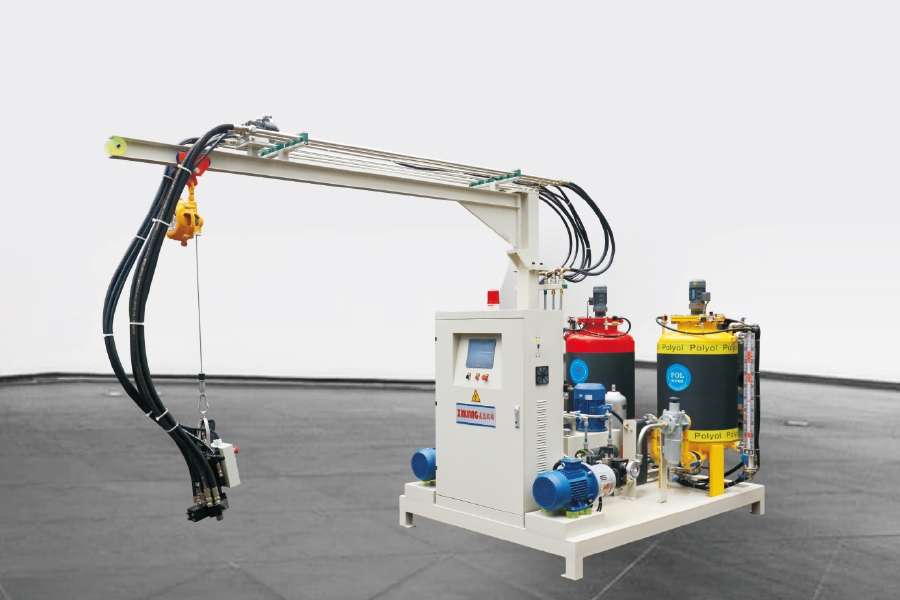
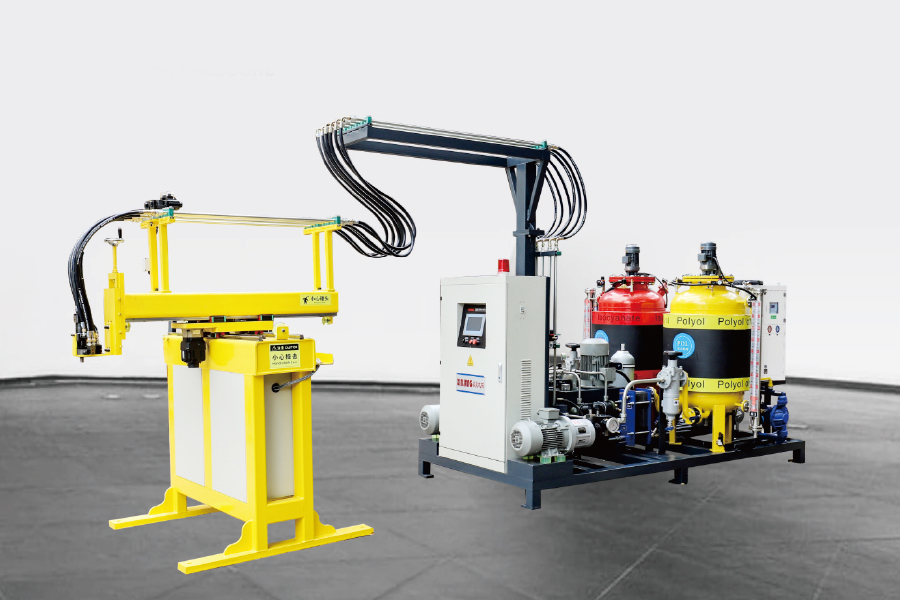
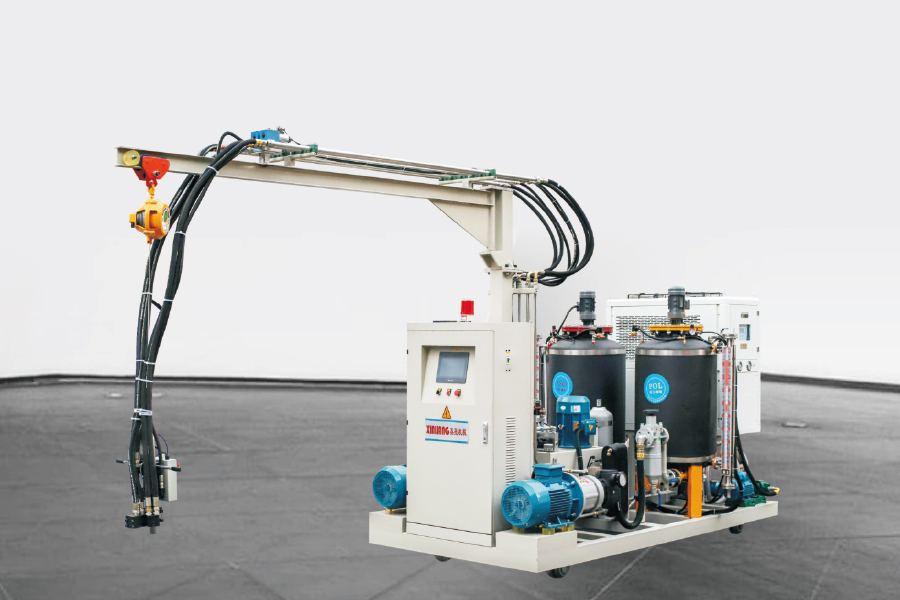
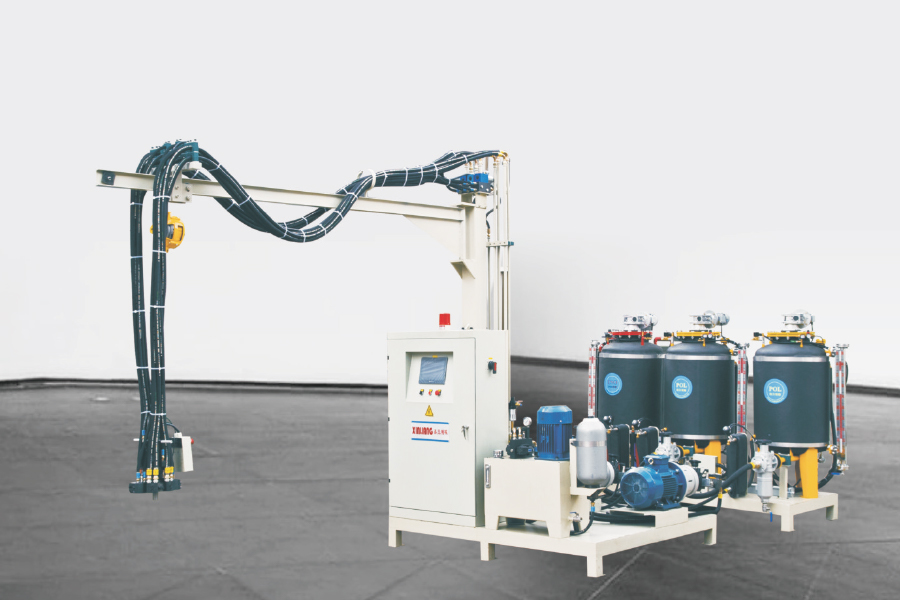
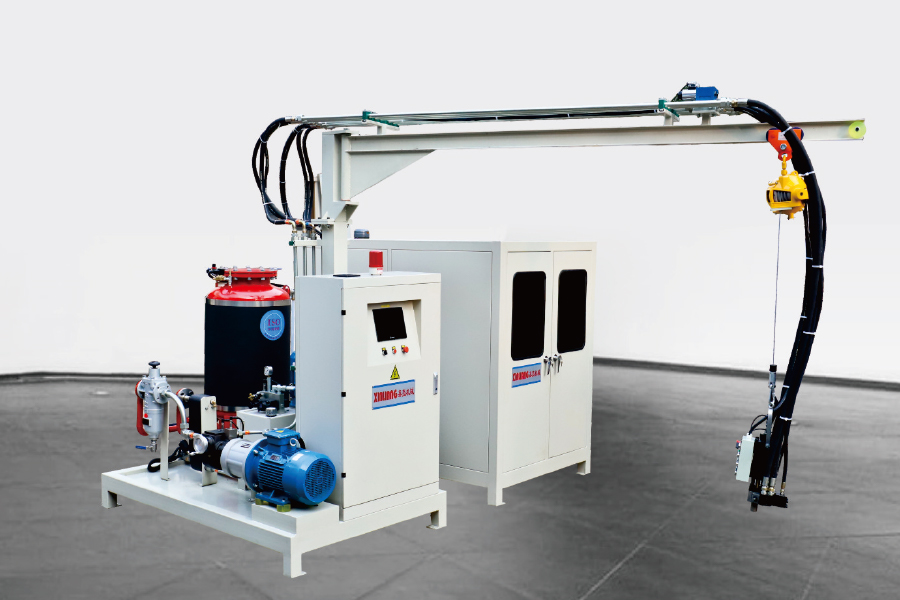
High-pressure impingement mixing works only when both streams arrive at the right pressure, temperature and ratio at the same moment. A machine with good headline pressure but poor low-shot repeatability will produce good panels on one shift and short shots on the next. Check three things before choosing a configuration: turn-down ratio, ratio accuracy at the smallest production shot, and temperature control from day tank to mixhead. The difference between high-pressure versus low-pressure foaming machines is not cosmetic; it changes whether the isocyanate-polyol reaction starts in the mixhead or in the mold.
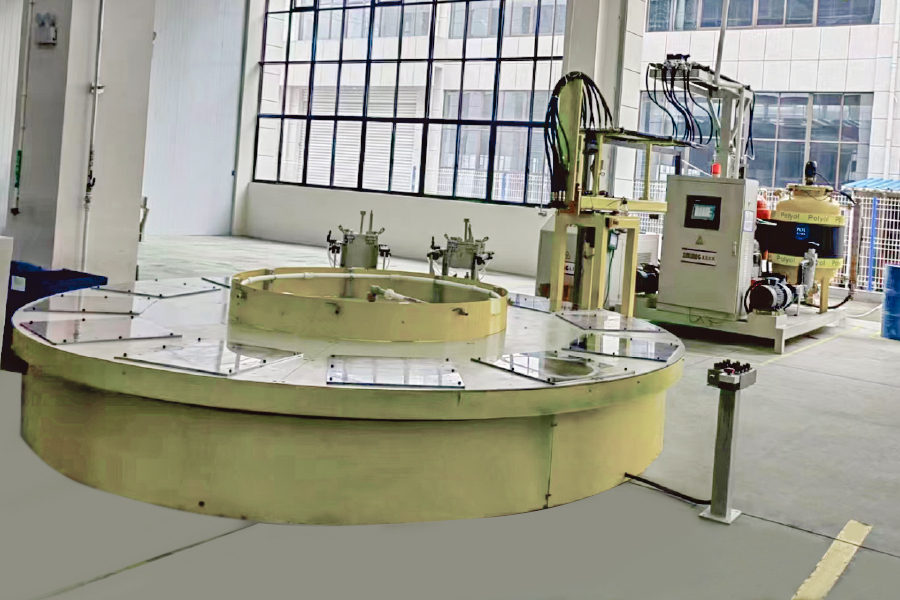
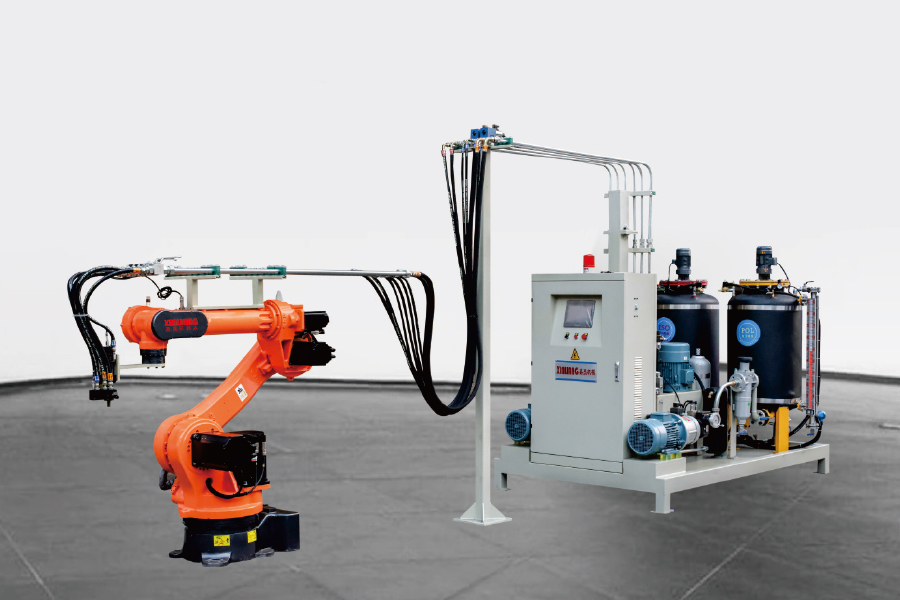
For a multi-station line, recipe stability must survive indexer dwell and shot-to-shot intervals. A turntable line can reduce operator travel, but only if the metering unit and gun path are matched to the cycle. The same rule applies to robot-mounted mixheads: repeatability is a ratio and pressure question before it is a motion question.
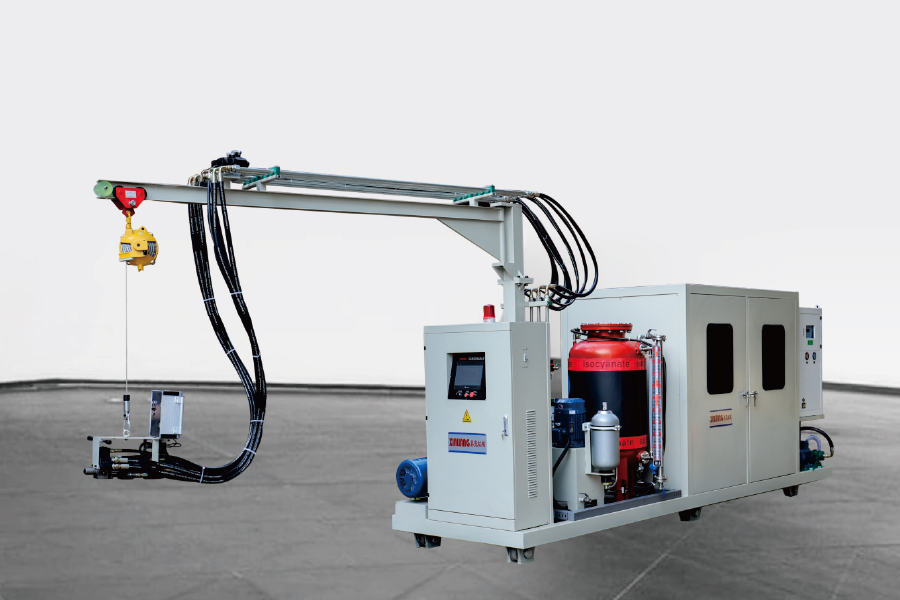
Figure 1. The ratio is set at the metering unit, but it is proven at the mixhead and in the mold.
Cyclopentane foaming: the polyol-isocyanate system is only half the recipe
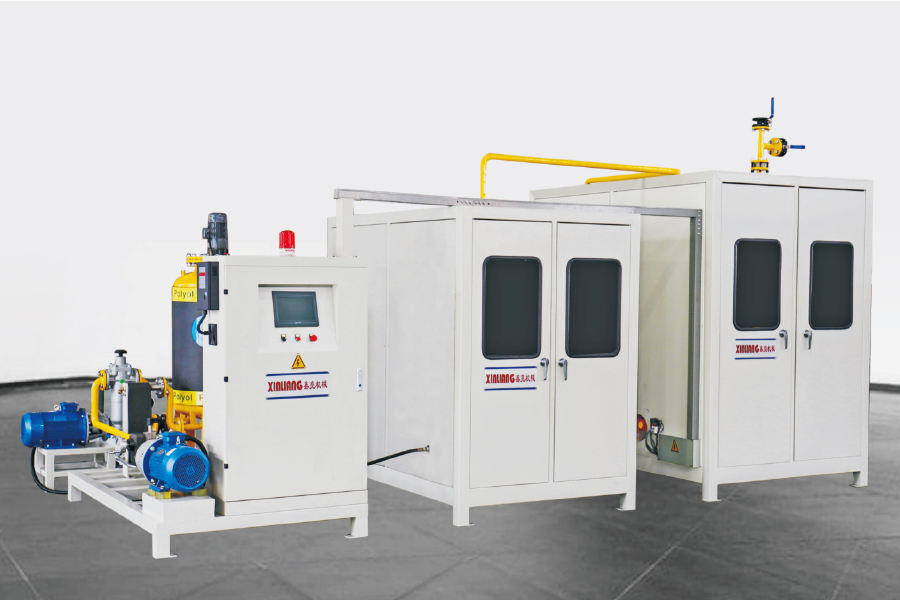
Cyclopentane changes the equipment conversation because it is a flammable physical blowing agent, not a drop-in replacement for water or HFCs. The polyol/isocyanate ratio still controls the polymer network, but the blowing agent has to be premixed, stored, metered and ventilated under controlled conditions. Static grounding, gas detection, explosion-proof electricals and consistent premix concentration are part of the process, not accessories. If the cyclopentane concentration drifts, density and dimensional stability drift with it, even when the NCO/OH index is perfect.
Before a purchase order, put these seven items on one page and make the supplier confirm the same assumptions.
Lot-specific OH value, %NCO, viscosity, water content and functionality.
Target index and allowed tolerance, not one fixed ratio.
Smallest and largest shot weights; confirm pump turn-down and ratio accuracy at both.
Process temperature window from day tank to mixhead, and how it is controlled.
Mixhead cleaning routine and solvent compatibility with the polyol blend.
For cyclopentane, premix accuracy, ventilation, grounding, gas detection and area classification.
Acceptance tests: ratio verification, shot repeatability, foam density, demold time and scrap rate.
Frequently asked questions
What is the difference between isocyanate and polyol?
Polyol provides hydroxyl groups; isocyanate provides NCO groups. They react to form urethane. In foam, the ratio and blowing agent decide density, strength and cure.
What is the correct isocyanate to polyol ratio for PU foam?
There is no universal ratio. Calculate equivalents from OH value and %NCO, set an index window, then validate it at production temperature and shot size.
Does polyol OH value affect foam hardness?
Yes. Higher OH value usually means more crosslinking and a stiffer foam, but isocyanate content, water and density also change hardness.
Why does my PU foam shrink or crack?
Common causes include index drift, overcatalysis, insufficient demold strength, or cyclopentane concentration variation. Check raw material COAs and shot ratio before changing the mold.
Can cyclopentane replace HFC blowing agents?
It can for many rigid foam applications, but it requires premix, ventilation, static control and explosion protection. The equipment and safety review are not optional.
What equipment is needed for high-pressure PU foaming?
Typically two metering tanks, high-pressure pumps, a mixhead, temperature control, and a mold or line. Cyclopentane adds a premix and safety system.


 English
 русский
 عربى