Home / News / Industry news / How Is Polyurethane Foam Manufactured? Step-by-Step Process and Equipment
How Is Polyurethane Foam Manufactured? Step-by-Step Process and Equipment
Industry news-
Cut into the wall of a refrigerator-freezer and you will find it: a rigid, pale-yellow foam insulating the whole cabinet behind a liner a few millimeters thick. Whether polyurethane foam ends up in a fridge, a car seat, or a roof panel, it is manufactured through the same fundamental sequence.
The short answer: manufacturers meter two liquid components — a polyol blend and an isocyanate — at a tightly controlled ratio, mix them at high pressure for a fraction of a second, inject the blend into a mold or onto a moving surface, and let a self-heating chemical reaction expand it into a cellular polymer within minutes. Temperature control, ratio accuracy, mixing energy, and mold handling all exist to keep that reaction repeatable, shot after shot.
This guide walks through the chemistry, the standard process steps, and the equipment decisions behind them — written from the equipment side of the industry by Ningbo Xinliang Machinery, a manufacturer of high-pressure polyurethane foaming machines and complete foaming lines, so the focus stays on what happens on the factory floor.
The Chemistry: Two Liquids That Build Their Own Structure
Polyurethane forms when a polyol — an alcohol with multiple reactive hydroxyl groups — reacts with an isocyanate: MDI for rigid and molded foams, TDI for slabstock cushioning. The reaction releases heat while it builds a polymer network, at the same time as gas is being generated inside the mixture. That pairing of structure-building and gas generation is what turns two liquids into solid foam.
Where the gas comes from
Two sources. Water in the formulation reacts with isocyanate and releases CO2, which inflates the cells. Physical blowing agents such as cyclopentane do not react at all — they vaporize in the heat of the reaction and do the expanding instead.
The supporting cast
Industry material references list the standard formulation inputs as polyols, diisocyanates, blowing agents, catalysts, and surfactants. Catalysts set how fast the polymer gels relative to how fast gas is produced; silicone surfactants keep the thin cell walls from rupturing while the foam rises; flame retardants and fillers adjust safety and cost.
Core inputs of polyurethane foam production and what each one controls.
Input
Function
What happens if it drifts
Polyol blend
Main resin; carries additives and defines base properties
Wrong ratio produces soft, weak, or brittle foam
Isocyanate (MDI/TDI)
Reacts with polyol to build the polymer network
Ratio drift causes shrinkage, voids, friable cells
Blowing agent (water/CO2, cyclopentane)
Creates the gas that forms the cells
Too much collapses the foam; too little leaves it dense
Catalysts
Balance gelling and gas-producing reactions
Poor balance causes split cells or a dense skin
Silicone surfactant
Stabilizes cell walls during rise
Coarse cells, craters, or collapse
The whole process balances on one comparison: if gas generation runs ahead of polymer build-up, the rising foam collapses; if the polymer gels too soon, the foam turns dense and pulls away from the mold. Formulators call this balancing the gel and blow reactions — and it is why metering accuracy is specified in fractions of a percent.
How Polyurethane Foam Is Manufactured, Step by Step
Whether the product is a molded car seat or refrigerator cavity insulation, the sequence runs through the same six stages:
Raw material preparation. Polyol and isocyanate are stored in day tanks and conditioned to a defined temperature window, commonly around 20-45°C depending on the system, because viscosity and reaction speed follow temperature closely.
High-pressure metering. Metering pumps deliver each component at a fixed ratio; well-maintained high-pressure units typically hold that ratio within about one percent.
Impingement mixing. The two streams are forced into a small mixhead at pressures commonly around 100-200 bar, where they collide and blend into a homogeneous mixture within milliseconds.
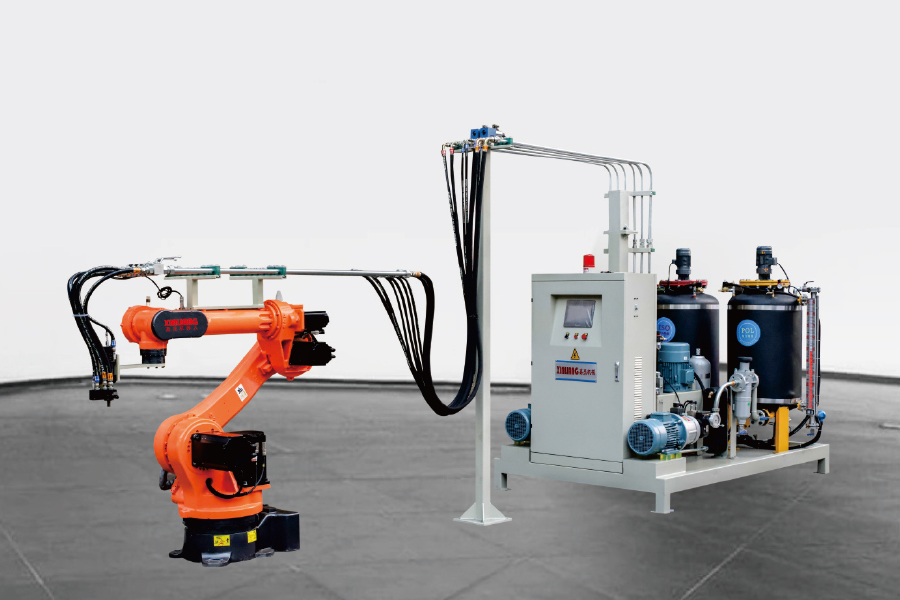
Injection or pouring. The blend is shot into a closed mold, poured into an open cavity, or laid onto a conveyor, guided by a robot or manipulator wherever the pour position must be exact.
Expansion and curing. The foam creams, rises, gels, and cures — cream phases last seconds, full rise usually takes one to two minutes, and demolding follows within a few minutes.
Demolding, trimming, and testing. Parts are released, trimmed, and checked for density, cell structure, dimensional stability, and, for insulation grades, thermal conductivity.
Illustrative volume-rise profile of a rigid foam system; exact timings vary with formulation and part geometry.
Two machine families dominate production. Low-pressure machines mix components in a chamber that must be flushed with solvent after every shot, which adds solvent handling, cleaning cost, and purge waste. High-pressure machines mix by impingement instead: the two streams collide at roughly 100-200 bar, and the mixhead cleans itself mechanically between shots. The payoff is finer, more uniform cells, no solvent consumption, and less material discarded — the reason high-pressure equipment has become the default for appliance, automotive, and panel production.
Typical working pressure ranges for the two machine families, as cited in foaming equipment literature; confirm exact figures against supplier datasheets.
Inside a high-pressure foaming machine
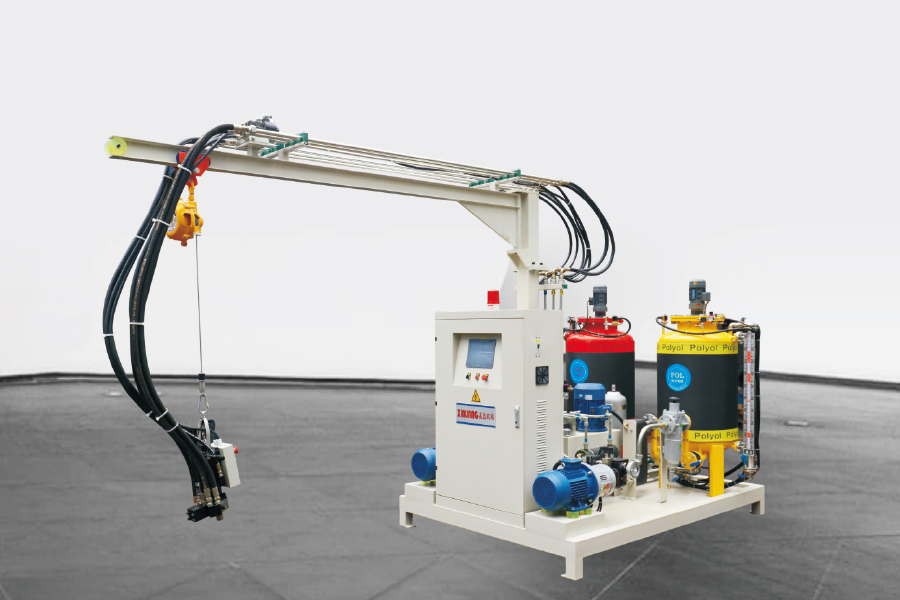
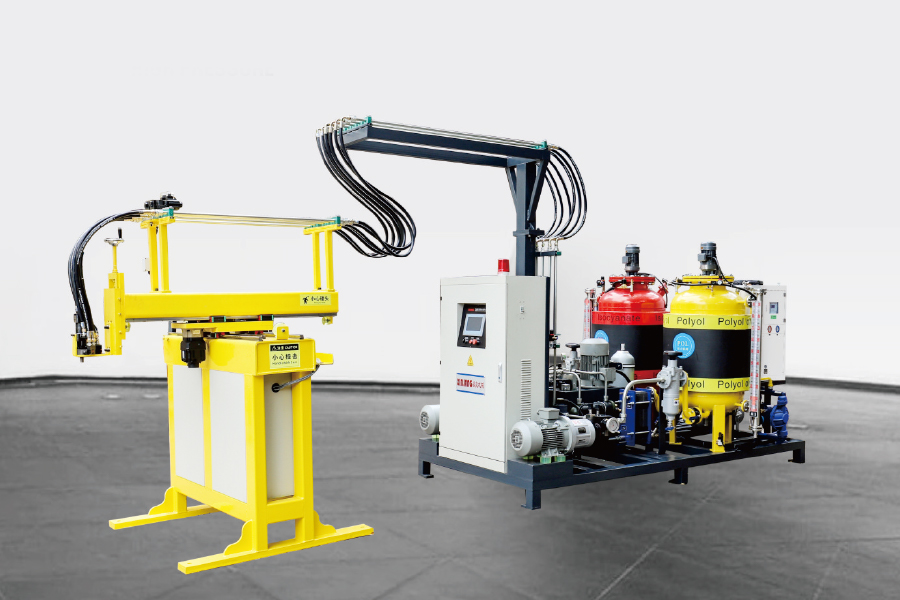
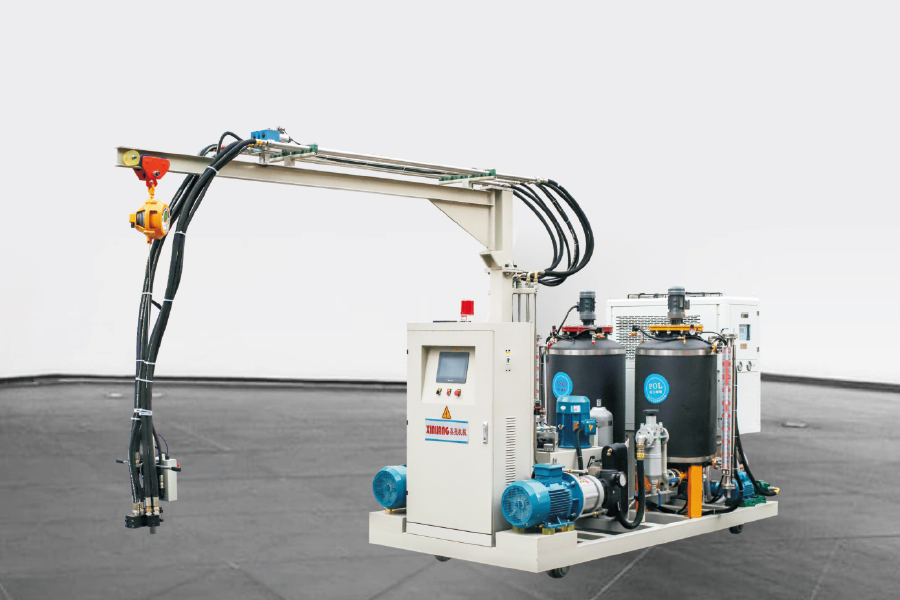
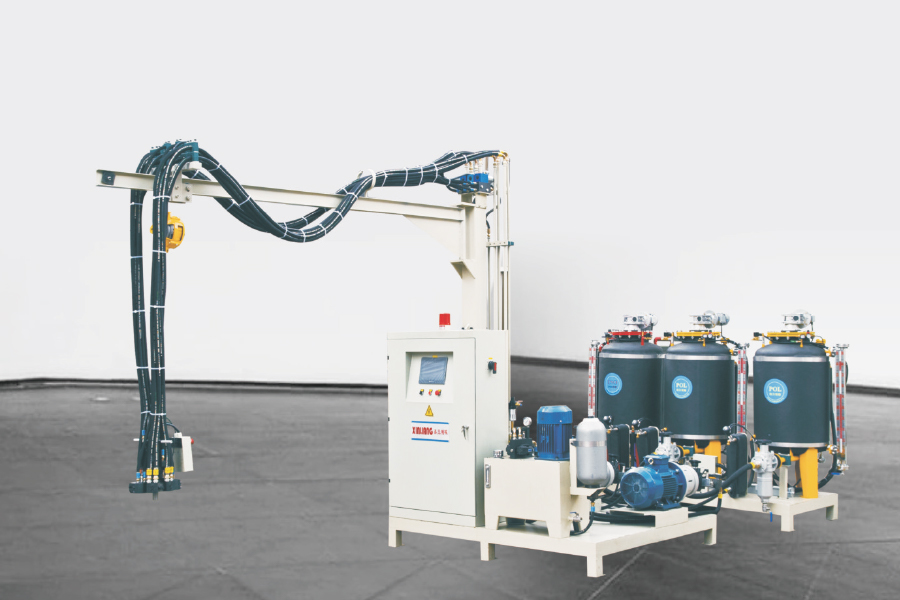
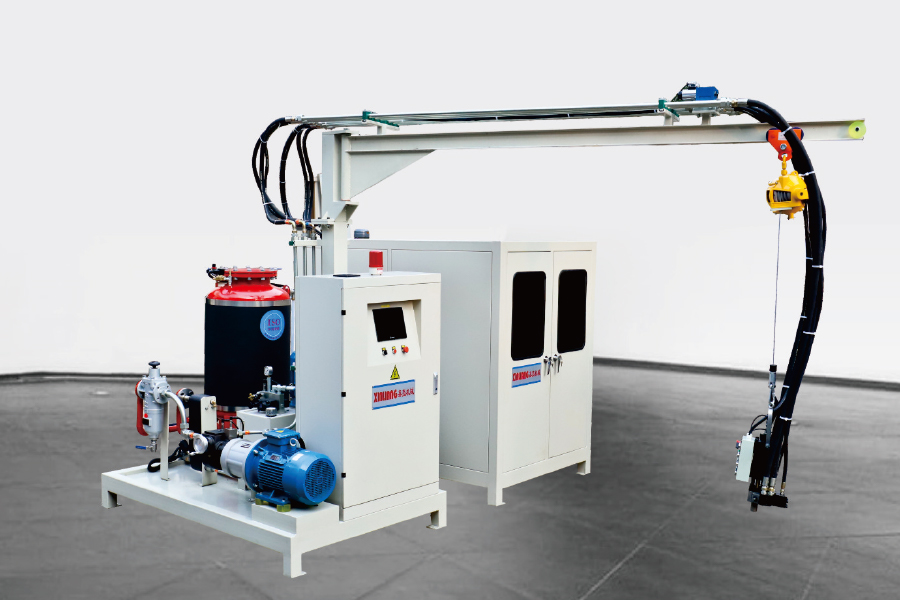
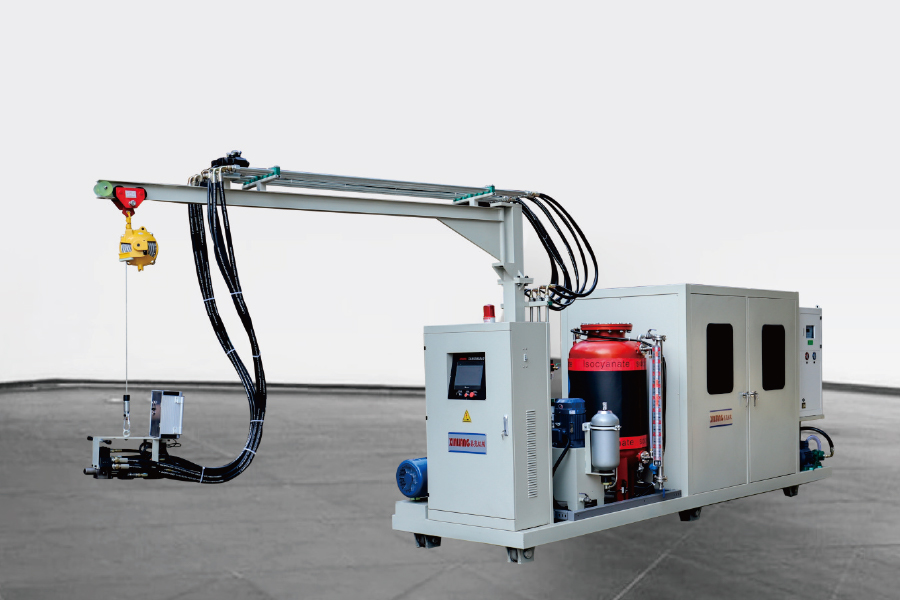
The hardware is more straightforward than it looks: two component tanks, metering pump units that set the ratio, insulated high-pressure hoses, and a self-cleaning mixhead positioned over the mold. Synchronize ratio, temperature, pressure, and shot timing, and every shot leaves the head with the same reactivity as the last.
Simplified structure of a two-component high-pressure foaming machine: component tanks, metering pumps, high-pressure hoses, self-cleaning mixhead, and mold.
Wikipedia's overview of polyurethane foam processing identifies two broad manufacturing routes: molding and slabstock. Slabstock lines pour a continuous stream onto a moving conveyor, where a long bun of foam rises, cures, and is later cut into blocks — the classic route for mattresses and furniture grades. Molding instead meters a shot into an individual mold for every part.
Rigid insulation foam is almost always molded: appliance makers inject foam into refrigerator cabinet cavities, panel producers run continuous laminating lines, and water-heater shells are filled in closed molds. Because its cells stay closed and trap the blowing agent, rigid foam acts as structure and insulation at once, with thermal conductivity as the headline property.
Refrigerator, freezer, and water-heater insulation
Sandwich panels for roofs, walls, and cold stores
Car seats and automotive interior trim
Mattresses, furniture, and shoe soles
Sports equipment, toys, and crafts
Each product family pulls the process in a different direction — resilience for seating, density and insulation value for appliances — so foam plants run separate formulations and tooling for each.
The Cyclopentane Shift: Foaming Without Fluorine
For decades, insulation foam relied on fluorinated blowing agents. International phase-outs under the Montreal Protocol pushed the industry first toward HCFCs and then to hydrocarbons, and cyclopentane is now the standard blowing agent for refrigerator, freezer, and panel insulation worldwide. It offers near-zero ozone depletion potential and low global warming potential; the trade-off is flammability, which production equipment must be engineered around.
Flammability is handled at the equipment level: explosion-proof motors and sensors, gas leak detection, and dedicated premixing hardware are standard requirements on cyclopentane lines, not optional extras.
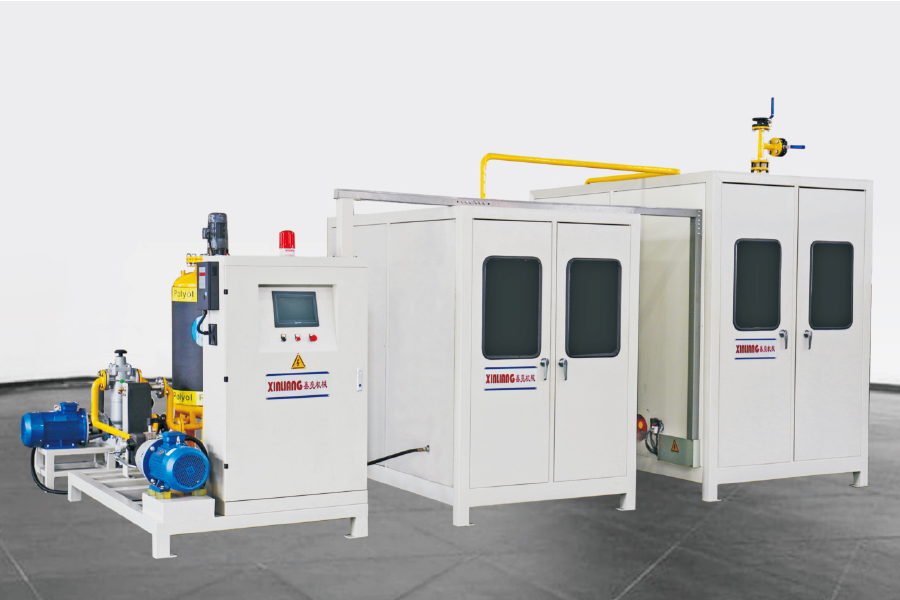
Two feeding approaches exist. Direct injection doses cyclopentane into the polyol stream at the machine itself, while a dedicated cyclopentane premix system prepares a stable polyol-blowing-agent blend upstream in a sealed, monitored station. Industry comparisons generally credit premixing with better raw-material uniformity and safer, more controllable dosing — a real advantage when insulation specifications are tight.
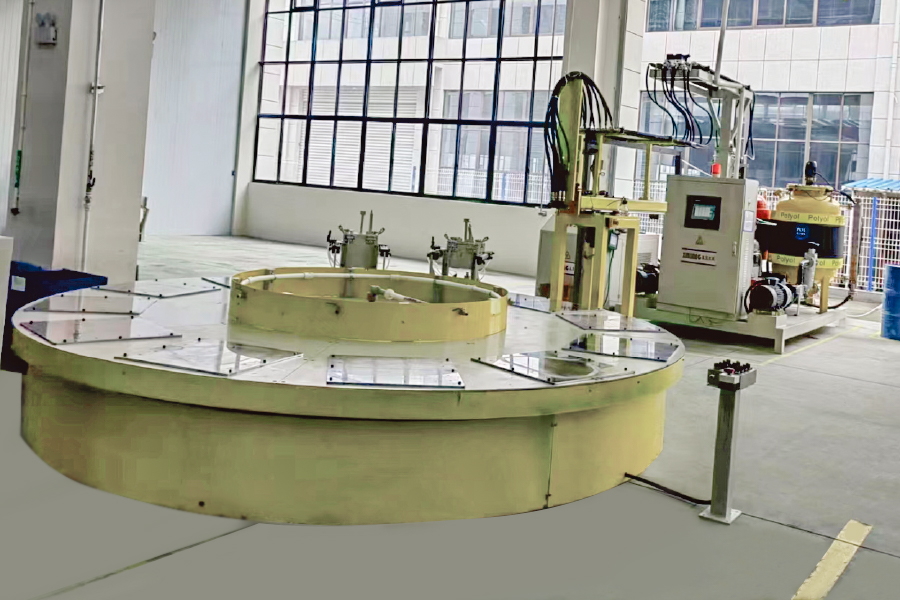
The chemistry never changes with scale; what changes is how molds move. A standalone machine suits research work, small batches, and frequently changing parts. A turntable line rotates mold carriers through pour, cure, and demold stations, fitting high-volume output into a compact footprint, while annular and H-type lines carry more carriers around continuous loops for maximum throughput. Case notes from foaming equipment suppliers attribute waste reductions of up to 30% to automated pour positioning with robots or manipulators alone.
Qualitative comparison on a 1-10 scale (illustrative): single machines lead on flexibility and entry cost; turntable and annular lines lead on output, automation, and shot-to-shot consistency.
Match the layout to the part: turntable cells dominate seating and appliance work where one compact cell serves dozens of molds a day, and annular layouts suit continuous, high-volume programs.
Finished foam earns acceptance through a short list of tests, most of which trace straight back to process control:
Density and density gradient across the part
Compression strength and deformation set
Dimensional stability after heat and humidity exposure
Thermal conductivity (k-factor) for insulation grades
Adhesion to liners and facings where foam bonds to skins
For buyers, the practical takeaway is simple: shrinkage, voids, and friable cells almost always trace back to ratio drift, temperature excursions, or worn mixheads. When comparing suppliers, ask specifically about metering accuracy, component temperature control, and cleaning and calibration routines — the answers predict your scrap rate better than any brochure.
Frequently Asked Questions
Q1: What is polyurethane foam made of?
A polyol blend and an isocyanate (usually MDI or TDI), plus a blowing agent, catalysts, and a silicone surfactant. Mixing the two main liquids triggers the reaction that locks bubbles into the polymer.
Q2: What is the difference between flexible and rigid polyurethane foam?
Flexible foam is open-cell and springs back after compression, so it is used for mattresses, furniture, and car seats. Rigid foam is closed-cell and valued for insulation in refrigerators and panels.
Q3: What does a polyurethane high-pressure foaming machine do?
It meters the two components at a fixed ratio, mixes them by high-pressure impingement in a self-cleaning head, and injects the blend into a mold within seconds, typically working around 100-200 bar.
Q4: How long does polyurethane foam take to cure?
Cream time is usually measured in seconds, full rise takes one to two minutes, and demolding follows within a few minutes depending on the formulation and part thickness.
Q5: Why is cyclopentane used as a blowing agent?
It offers near-zero ozone depletion potential and low global warming potential, which made it the standard choice for appliance and panel insulation after fluorinated agents were phased out.
Q6: Is polyurethane foam safe?
Fully cured foam is stable and is used in everyday products worldwide. Handling precautions apply to the liquid raw chemicals, which require ventilation, protective equipment, and trained operators.
Q7: What products are made with polyurethane foam?
Refrigerator and freezer insulation, water heaters, sandwich panels, car seats and interior parts, mattresses, furniture, shoe soles, sports equipment, and toys.
Q8: How much does a polyurethane foaming machine cost?
It depends on the number of components, pressure class, automation level, and whether a complete production line is required — the dependable route is a configuration-based quotation from the equipment maker.


 English
 русский
 عربى
عربى