Home / News / Industry news / Can High Pressure PU Foaming Machines Improve Production Efficiency?
Can High Pressure PU Foaming Machines Improve Production Efficiency?
Industry news-
Yes — high pressure PU foaming machines significantly improve production efficiency, and the performance gap versus low-pressure systems is measurable across throughput, material yield, cycle time, and product consistency. A modern High Pressure PU Foaming Equipment system operates at mixing pressures of 100–200 bar, enabling precise impingement mixing of polyol and isocyanate components without mechanical agitators. The result is a faster, cleaner, and more repeatable foaming process that directly translates to higher output per shift and lower per-unit production cost — making it the standard choice for high-volume polyurethane manufacturing.
How High Pressure Foaming Technology Drives Efficiency
The efficiency advantage of high pressure systems is rooted in their mixing mechanism. Rather than using rotating mixing heads that require cleaning between shots, high pressure impingement mixing uses the kinetic energy of two high-velocity chemical streams colliding in a compact mixing chamber. When the shot cycle ends, the pistons retract and self-clean the chamber — eliminating solvent flushing and reducing inter-shot downtime to seconds.
Core Efficiency Mechanisms
Self-cleaning mixing head: No solvent required between shots. Inter-shot interval is reduced to 3–8 seconds, compared to 30–90 seconds for low-pressure systems requiring mechanical cleaning.
Precise ratio control: High pressure pumping systems maintain component ratios within ±0.5%, ensuring consistent foam density and mechanical properties from the first shot to the last.
Rapid shot response: Electronically controlled valves and servo-driven metering pumps allow output to be adjusted shot-by-shot, accommodating varying mold sizes without material waste.
High output rates: Industrial high pressure machines deliver output flows of 200–2,000 g/s, enabling rapid mold filling for large components such as refrigerator cabinets, automotive headrests, and insulation panels.
Inter-Shot Downtime by Foaming System Type (seconds)
High Pressure (Self-Cleaning Head)
3–8s
Low Pressure (Mechanical Clean)
30–60s
Low Pressure (Solvent Flush)
60–90s
High pressure self-cleaning systems reduce inter-shot downtime by up to 90% compared to solvent-flush low-pressure machines.
Production Output: What the Numbers Show
Efficiency improvements in PU Foam Production Machines are best understood through concrete production scenarios. The following comparison uses a standard refrigerator cabinet foaming line as a reference case — one of the most common high-volume applications for polyurethane insulation foam.
Parameter
High Pressure System
Low Pressure System
Inter-shot cleaning time
3–8 seconds
30–90 seconds
Mixing ratio accuracy
±0.5%
±2–5%
Units per 8-hour shift (cabinets)
180–240
80–120
Material waste rate
< 1%
3–8%
Solvent consumption
None
Significant (per-shift cost)
Defect rate (density variation)
0.5–1.5%
3–6%
Production performance comparison between high pressure and low pressure PU foaming systems in a refrigerator cabinet application.
Understanding the engineering behind High Pressure PU Foaming Equipment helps production managers make informed decisions when specifying or upgrading systems. The following components are critical to machine performance:
Metering and Pumping System
High-precision axial piston pumps or gear pumps meter polyol and isocyanate components at controlled flow rates and pressures. Servo-motor driven systems offer flow rate accuracy of ±0.3% and allow electronic adjustment of output ratio without mechanical intervention — essential for multi-formulation production lines.
Self-Cleaning Mixing Head
The mixing head is the core of the high pressure system. Hardened steel pistons retract after each shot, mechanically wiping the chamber clean in under 100 milliseconds. This eliminates chemical residue buildup and maintains consistent mixing quality across thousands of consecutive cycles — typical mixing head service life exceeds 5 million shot cycles with proper maintenance.
Temperature Control System
Component temperature directly affects foam reactivity and final cell structure. Industrial high pressure machines maintain tank and line temperatures within ±0.5°C of setpoint using closed-loop heating and cooling circuits — a level of thermal precision not achievable with manual or basic low-pressure systems.
PLC Control and Data Logging
Modern systems integrate programmable logic controllers with touchscreen HMIs, enabling recipe storage for multiple foam formulations, real-time monitoring of pressure, flow, and temperature, and automatic shot logging for quality traceability. This supports lean manufacturing requirements and facilitates rapid changeover between product types.
When integrated into a closed-mold tooling setup, a high pressure foaming unit becomes a Polyurethane Injection Molding Machine — capable of producing structural foam, integral skin foam, and reaction injection molded (RIM) components with tight dimensional tolerances. This configuration expands the range of achievable products significantly:
Automotive interior components: Headrests, armrests, steering wheel pads, and instrument panel foam require consistent density and surface quality — achievable with high pressure closed-mold injection.
Furniture and seating: Flexible molded foam for office chairs, sofas, and mattress toppers benefits from the consistent cell structure produced by impingement mixing.
Insulation panels: Continuous or batch lamination lines for refrigeration, construction, and cold chain panels rely on high output rates and precise foam density control.
Footwear soles: PU sole molding requires shot weights of 50–300 g with precise timing — high pressure systems with servo-controlled dispensing meet this requirement reliably.
Medical and filtration products: Specialty rigid foam components for medical devices and filter housings require exact ratio control and contamination-free mixing.
Mixing quality improves sharply as operating pressure increases from low-pressure range (10–40 bar) to high-pressure range (120–160 bar), where impingement mixing reaches full effectiveness.
Material Savings and Waste Reduction in PU Foam Production
Beyond throughput, a PU Foam Production Machine operating at high pressure delivers measurable material savings that compound across high-volume production runs. Polyol and isocyanate are among the most significant raw material costs in polyurethane manufacturing, and even small improvements in utilization rate have substantial impact at scale.
No solvent waste: Self-cleaning head operation eliminates the 50–200 ml of solvent consumed per cleaning cycle in low-pressure systems. For a line running 400 shots per shift, this eliminates up to 80 liters of solvent waste per day.
Reduced purge waste: Low-pressure machines require purge shots after extended downtime to clear residue. High pressure systems restart cleanly within 1–2 shots, saving 200–500 g of mixed material per restart event.
Lower defect-related rework: Consistent mixing ratio reduces foam density variation, cutting rejection rates from a typical low-pressure 3–6% to under 1.5% — saving the material and labor cost of reworking or scrapping non-conforming parts.
Optimized shot weight control: Electronic shot-weight control with ±1 g repeatability prevents overfilling of molds — a common source of material waste in manually adjusted systems.
Choosing the Right High Pressure Foaming System for Your Production Line
Selecting the appropriate system involves matching machine specifications to production requirements. The following parameters guide the selection process:
Selection Criterion
Guidance
Typical Range
Output flow rate
Match to largest mold fill time requirement
200–2,000 g/s
Mixing ratio range
Must cover all product formulations
100:20 to 100:60 (polyol:ISO)
Operating pressure
Higher pressure for lower-viscosity or filled systems
100–200 bar
Number of components
2-component standard; 3+ for color or additive streams
2–5 components
Temperature control zones
Tanks, feed lines, and mixing head independently controlled
3–8 zones
Automation level
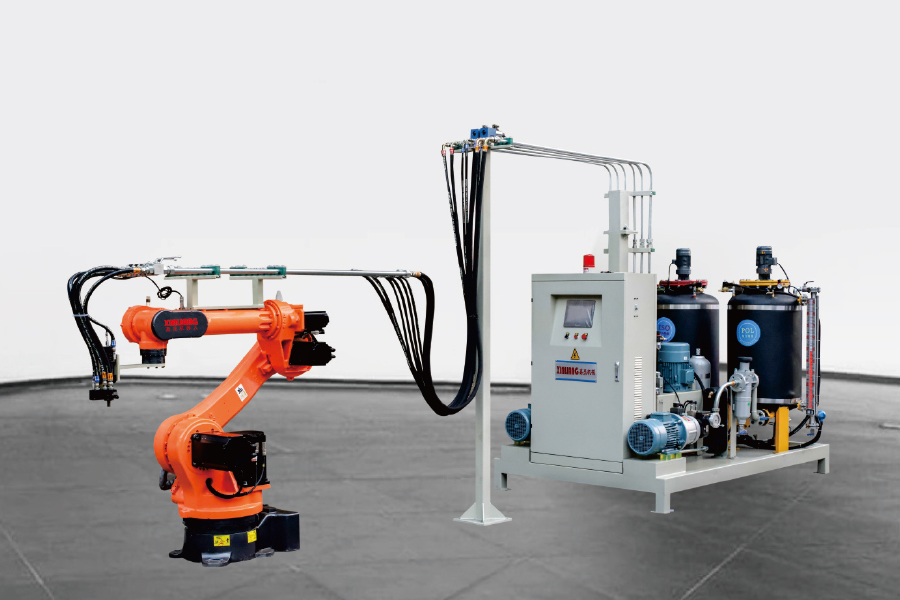
Robot-arm integration for high-volume unmanned lines
Semi-auto to full CNC
Key specification parameters for selecting a high pressure PU foaming machine suited to your production requirements.
About Ningbo Xinliang Machinery Co., Ltd.
Ningbo Xinliang Machinery Co., Ltd. is an enterprise combining industry and trade, dedicated to producing polyurethane foaming equipment, polyurethane foaming production lines, and cyclopentane polyurethane foaming complete equipment. It is a professional high-tech enterprise specializing in polyurethane foaming equipment research and development, manufacturing, and technical services, with more than ten years of professional design experience and deep familiarity with advanced polyurethane foaming equipment technology at home and abroad.
As a professional Custom Polyurethane High Pressure Foaming Injection Machine Supplier and OEM Company, Ningbo Xinliang relies on Zhejiang's strong industrial foundation and strategic location advantages to pursue a development path of scientific and technological innovation and specialization. The company focuses on providing customized solutions for users across the polyurethane industry — from project consultation and equipment design to production line commissioning and ongoing technical support.
Customers from all industries — including refrigeration, automotive, furniture, construction, and footwear — are welcome to visit, discuss technical requirements, and explore OEM and custom production cooperation.
Frequently Asked Questions
Q1: What is the main advantage of high pressure over low pressure PU foaming machines?
The primary advantages are self-cleaning mixing head operation, higher throughput, and tighter mixing ratio control. High pressure impingement mixing eliminates the need for solvent cleaning between shots, reducing inter-shot downtime by up to 90% and improving mixing homogeneity — leading to more consistent foam quality across production runs.
Q2: What types of polyurethane foam can high pressure machines produce?
High pressure PU foaming machines are compatible with rigid foam, flexible foam, integral skin foam, semi-rigid structural foam, and elastomers. The specific formulation, mixing ratio, and tool configuration determine the foam type — making the same machine adaptable to multiple product lines with recipe changes.
Q3: Can high pressure foaming machines be integrated with robotic automation?
Yes. Most industrial high pressure foaming machines support robot arm or gantry integration via standard communication interfaces (e.g., digital I/O, Profibus, EtherCAT). This enables fully automated mold handling, mixing head positioning, and shot triggering — essential for high-volume unmanned production in automotive and appliance manufacturing.
Q4: How is shot weight accuracy maintained in a high pressure system?
Shot weight is controlled through precisely timed valve opening, servo-controlled pump speed, and real-time flow measurement feedback. High-end systems achieve shot weight repeatability of ±1 g across thousands of consecutive cycles, minimizing material waste from mold overfilling and ensuring dimensional consistency of molded parts.
Q5: Is it possible to customize a high pressure foaming machine for cyclopentane blowing agents?
Yes. Cyclopentane-compatible high pressure foaming systems require explosion-proof electrical components, sealed tank and line systems, and dedicated ventilation. Manufacturers experienced in cyclopentane equipment design — particularly for refrigerator and freezer insulation lines — can supply fully compliant systems built to relevant safety standards.


 English
 русский
 عربى
عربى