Home / News / Industry news / PU Sandwich Panel Production Line: Layout, Foaming Unit & Buying Checks
PU Sandwich Panel Production Line: Layout, Foaming Unit & Buying Checks
Industry news-
A PU sandwich panel production line succeeds or fails on one number: the mass flow of foam entering the cavity. Get that wrong and the best double-belt in the world will still ship panels with density drift, voids along the edges and flatness that fails your customer's tolerance.
So before comparing line speeds, compare the chemistry and the dosing hardware behind it. This guide covers how a PU sandwich panel production line is arranged, what the foaming unit actually controls, and which specifications are worth arguing about during a quotation review.
How a PU sandwich panel production line is arranged
A continuous line is a train of stations. Each one can stop the whole train, and each one changes the working conditions of the next:
Decoiler and coil car for top and bottom steel facers, with tension control that keeps waviness out of the finished panel.
Roll forming or embossing, which gives the facer its rib profile and bending stiffness.
Pre-heating, bringing facer temperature to a stable band (commonly 35–45 °C) so adhesion does not drift with the weather in the yard.
Foaming station, where a high-pressure injection unit pours into the cavity formed by two facers and the side seals.
Double-belt curing section, applying pressure and heat while the foam rises, gels and cures. Its length is set by the cure time your foam system needs at the design speed.
Flying saw, edge trim and stacker.
Every station is quoted with its own tolerance, but they interact. A one-degree swing in facer temperature shifts cream time at the interface; a slack side seal shows up as a foam bleed line many metres downstream. The main components of a polyurethane foam production line are usually listed as separate items, yet on the floor they behave as one chain.
1 Decoiler and forming · 2 Pre-heating · 3 Foaming station · 4 Double-belt curing · 5 Saw and stacker
Continuous double belt or batch press line?
Conclusion first: choose continuous when one or two panel families run for most of the year, and choose a discontinuous line when your order book is a mix of thicknesses, lengths and facer profiles. Everything else is arithmetic on changeover time.
Comparison based on typical configurations quoted by sandwich panel line suppliers; real figures depend on panel type, belt length and automation level.
Criterion
Continuous double-belt line
Discontinuous press line
Output measure
Metres per minute, continuous
Panels or shots per shift
Panel length
Cut to order from a continuous slab
Limited by press and mould length
Changeover
Slow: belt gap, seals and chemistry reset
Fast: swap moulds and recipes
Foam density control
Depends on steady metering over hours
Depends on shot repeatability
Best fit
Roof and wall panels, cold storage, steady volume
Mixed orders, small batches, staged investment
The foaming unit sets the ceiling on quality
Here is the calculation that decides whether a quoted line speed is real. A 1,000 mm wide, 50 mm thick panel at 8 m/min needs 1.0 × 0.05 × 8 = 0.40 m³ of foam per minute. At 40 kg/m³ that is 16 kg/min; at 12 m/min it becomes 24 kg/min. If the injection unit tops out at 18 kg/min, your "12 m/min line" is a 9 m/min line, whatever the belt is rated for.
Beyond output, three behaviours of the metering unit show up directly in the panel:
Ratio hold. High-pressure machines mix by impingement at roughly 100–200 bar and typically hold component ratio within about ±0.5%. Low-pressure machines rely on mechanical mixing and drift more at low output, which shows as density variation along the slab.
Temperature conditioning. Polyol and isocyanate viscosity both move with temperature. A well-conditioned unit keeps them within about ±1 °C, so cream time stays where the recipe says it should.
Repeatability at the low end. Most lines are commissioned at maximum speed and then run at 60–70% of it; check ratio accuracy at minimum output, not just at the headline figure.
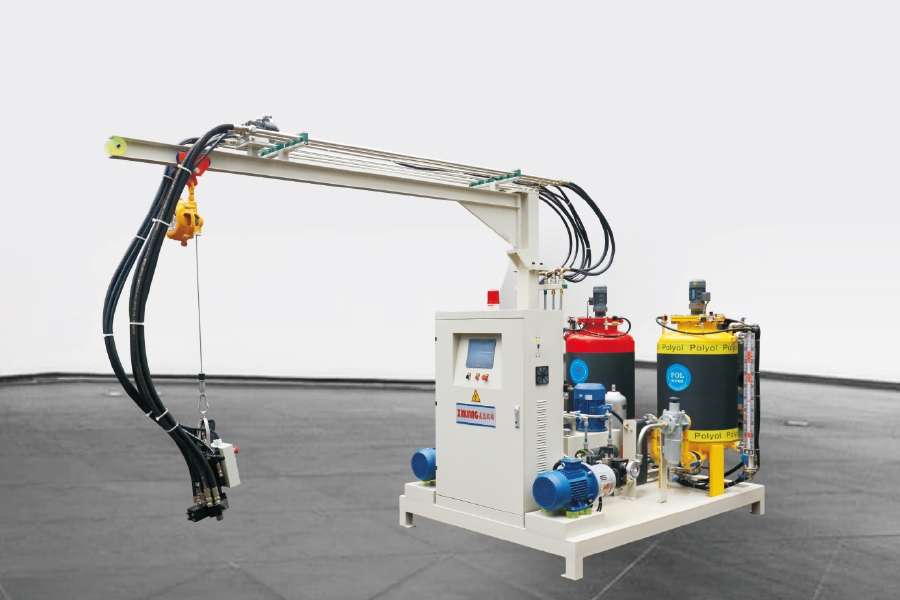
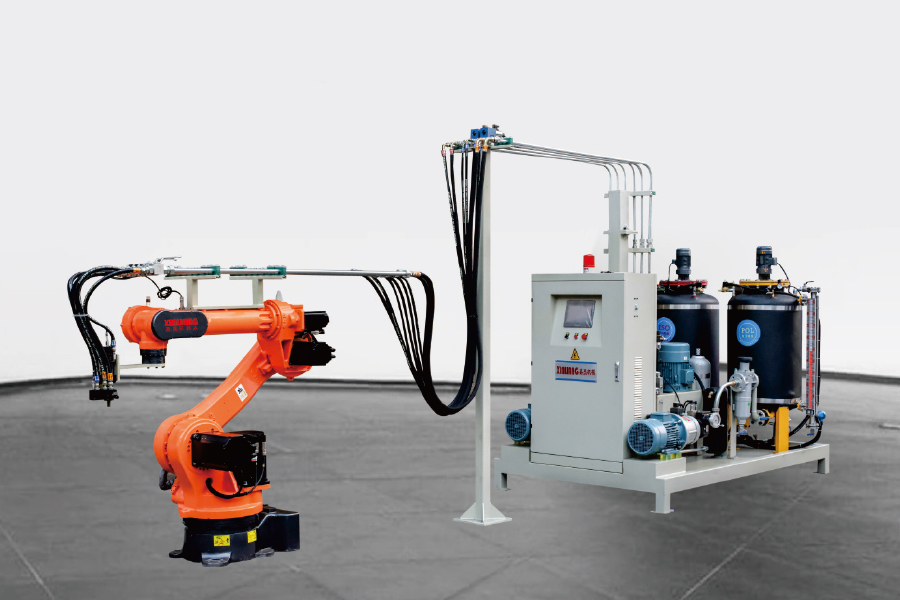
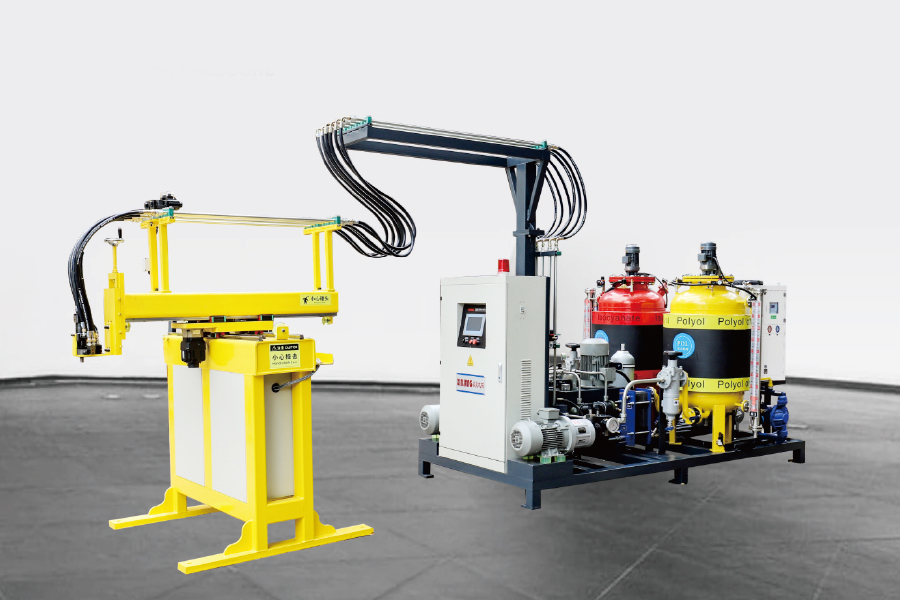
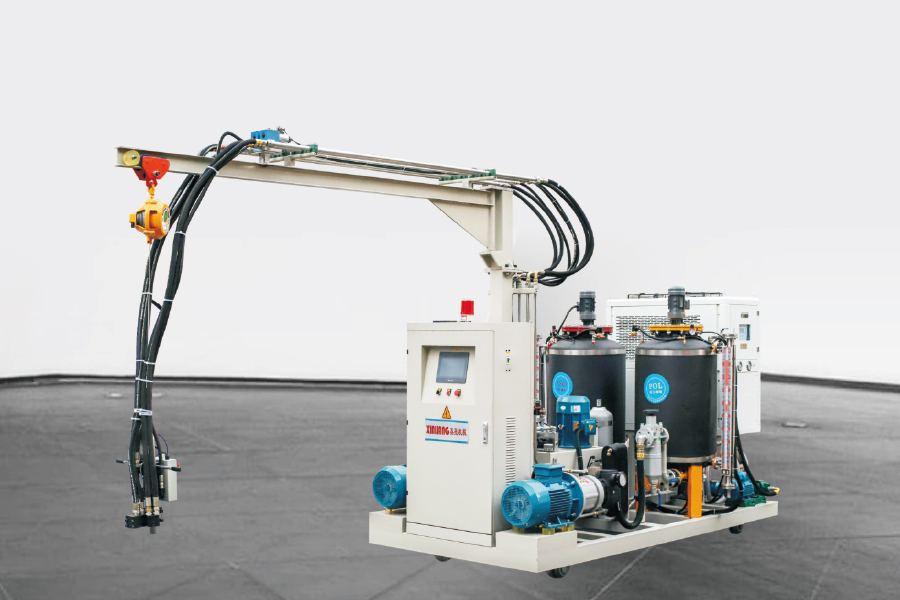
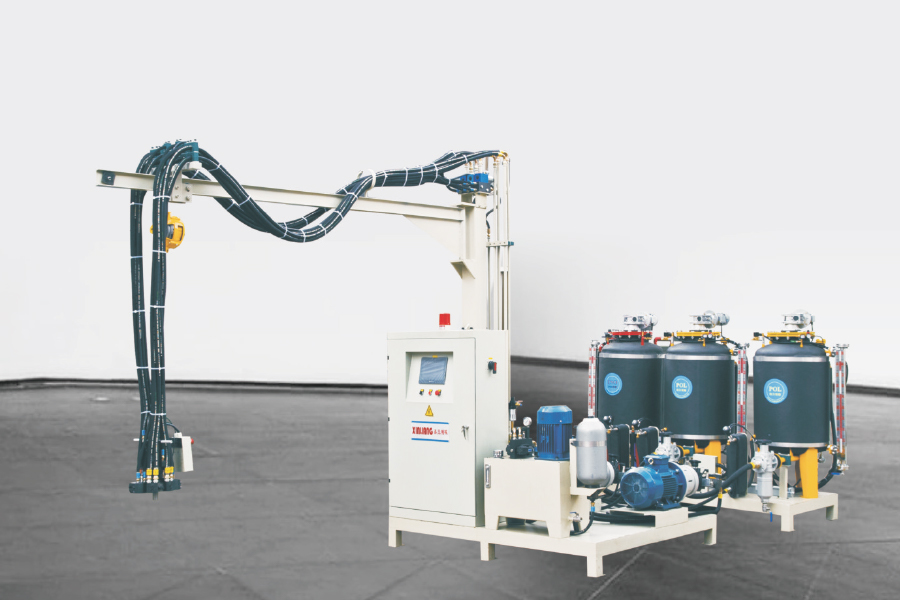
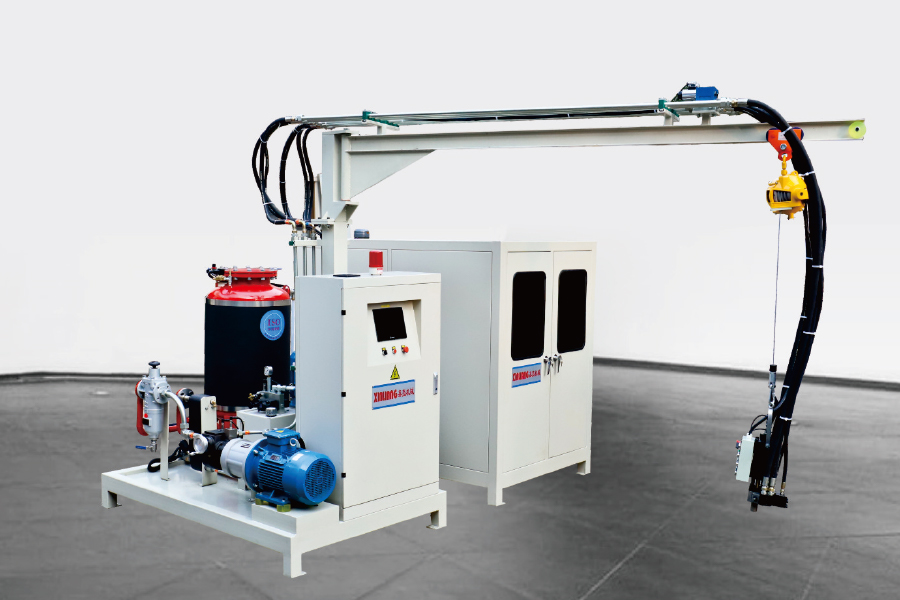
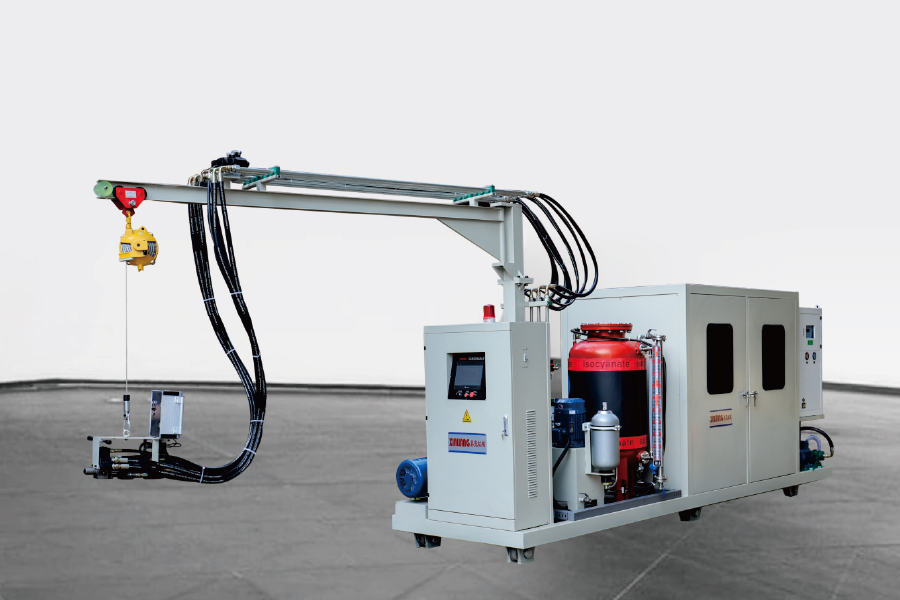
For a sandwich panel line the injection unit is usually a two-component high-pressure machine sized to the pour rate above, with the mix head mounted on a traversing carriage so the pour pattern follows line speed.
Cyclopentane, pentane and the premix decision
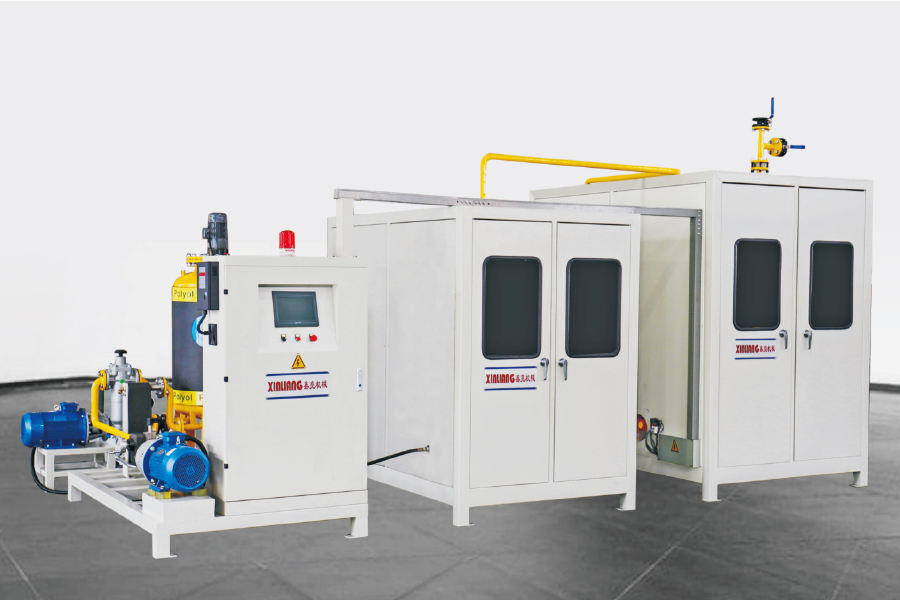
Hydrocarbon blowing agents change the equipment list, not just the recipe. Cyclopentane and pentane are flammable, and their vapour is heavier than air, so it collects in pits and low corners. A compliant line therefore carries gas detection at the foaming station and in the pit, explosion-proof electrics, higher ventilation rates, nitrogen blanketing of the day tank, and bonding and earthing across every steel section.
The second addition is a premix system. Blowing agent has to stay dispersed in the polyol; left to settle in a day tank, it stratifies and density drifts across a long run. A premix unit blends under controlled pressure and keeps the mixture circulating, which is why hydrocarbon lines quote it as a separate module rather than an accessory.
Foam reactivity is described by cream, gel, rise and tack-free times. On a continuous line the panel must be self-supporting before it leaves the belt's pressure zone, otherwise belt marks stay in the surface and the edges stay soft. Thicker cavities have further to rise and lose heat more slowly, so design speed falls as thickness climbs.
Indicative relationship: thicker cavities need longer rise and cure time, so design speed falls. Actual values shift with formulation, facer temperature and belt length.
Core chemistry changes the hardware
PU and PIR cores are both foamed in place, but PIR runs at a higher isocyanate index. That gives better fire behaviour and a more rigid core, and it makes the process far less forgiving of ratio drift — the burden lands on metering accuracy and temperature conditioning rather than on the operator. Mineral wool is a different line entirely: the lamellae are bonded with adhesive, so there is no injection unit and no cavity to fill.
Indicative manufacturer-declared values at a mean temperature of 10 °C; lower is better. Core choice drives whether the line needs injection, adhesive lamination or both.
What to verify in the quotation
Items that decide whether a line meets its rated speed six months after commissioning.
Check
What to ask for
Why it matters
Dosing repeatability
Documented ratio accuracy at minimum and maximum output
Density drift and overfill appear first at low output
Output headroom
Mass flow at design speed plus about 20%
Lets you raise speed later without a new pump
Temperature control
±1 °C on both component lines
Viscosity and cream time follow temperature
Belt pressure uniformity
A pressure map across the belt, not one setpoint
Sets flatness and thickness tolerance
Side seal wear parts
Priced separately with lead times
Seal wear is the usual cause of edge voids
Control and records
Recipe storage, alarm log, batch traceability
Repeatable changeovers and auditable production
Four questions are worth asking before you sign: who owns the interface between the foaming unit and the line PLC; are mix heads and metering pumps stocked locally; what is the documented cure time for your foam system at both 25 mm and 150 mm; and can the line run PIR without changing pumps?
Frequently asked questions
What is a PU sandwich panel production line?
A linked set of machines that turns steel facers and a polyurethane foam system into insulated panels: decoiler, roll former, pre-heater, foaming station, double-belt curing section, saw and stacker. The foaming unit meters, mixes and injects the reactive components into the moving cavity.
How much does a PU sandwich panel production line cost?
Suppliers rarely publish prices, because belt length, foaming output and automation are specified per project. A batch press line costs a fraction of a continuous double-belt line, and inside a continuous line the double-belt section and foaming unit dominate the budget. Ask for a section-by-section breakdown.
Continuous or discontinuous sandwich panel line?
Continuous suits one or two panel families at steady volume. Discontinuous suits mixed thicknesses, short runs and frequent changeovers, and it is easier to commission and to fund in stages.
What line speed can a PU sandwich panel production line reach?
Continuous lines commonly run in the 3–12 m/min range depending on panel thickness and foam system. Speed is limited by rise and cure time, not by the belt drive, so thick panels always run slower than thin ones.
Which foaming machine is used for PU sandwich panels?
A high-pressure two-component injection machine sized to the pour rate — for example 16–24 kg/min for a 50 mm panel at 8–12 m/min. Cyclopentane-blown systems add a premix module and a gas-detection package.
Can one line produce both PU and PIR panels?
Usually yes, provided the metering unit has enough ratio range and holds temperature tightly. PIR runs at a higher isocyanate index and tolerates less ratio drift, so confirm the recipe window with your foam system supplier.
A PU sandwich panel production line is a chain, and its weakest link is nearly always the interface between chemistry and dosing. Fix that first — pour rate matched to speed, ratio held within tolerance, blowing agent kept dispersed — and the belt, saw and stacker will deliver the flatness and density you promised. Get it wrong, and every other specification on the datasheet becomes a number nobody can reach.


 English
 русский
 عربى