Home / News / Industry news / Can High Pressure PU Foaming Machines Improve Production Efficiency in 2026?
Can High Pressure PU Foaming Machines Improve Production Efficiency in 2026?
Industry news-
Direct Answer: Yes — a polyurethane high pressure foaming injection machine can significantly improve production efficiency in 2026. Compared to low-pressure or manual foaming methods, high-pressure systems achieve mixing ratios accurate to within ±1%, cycle times as short as 3–8 seconds per shot, and continuous output rates exceeding 20 kg/min on large-format machines. When properly integrated into an automated production line, these machines reduce material waste, lower labour dependency, and deliver consistent part quality across high-volume runs — all of which translate directly into measurable gains in throughput and operational efficiency.
This article examines how a polyurethane high pressure foaming injection machine operates, what efficiency improvements are achievable with real data, which industries benefit most, and what to consider when selecting or specifying a custom PU foaming injection machine for a production environment.
How a High Pressure PU Foaming Injection Machine Works
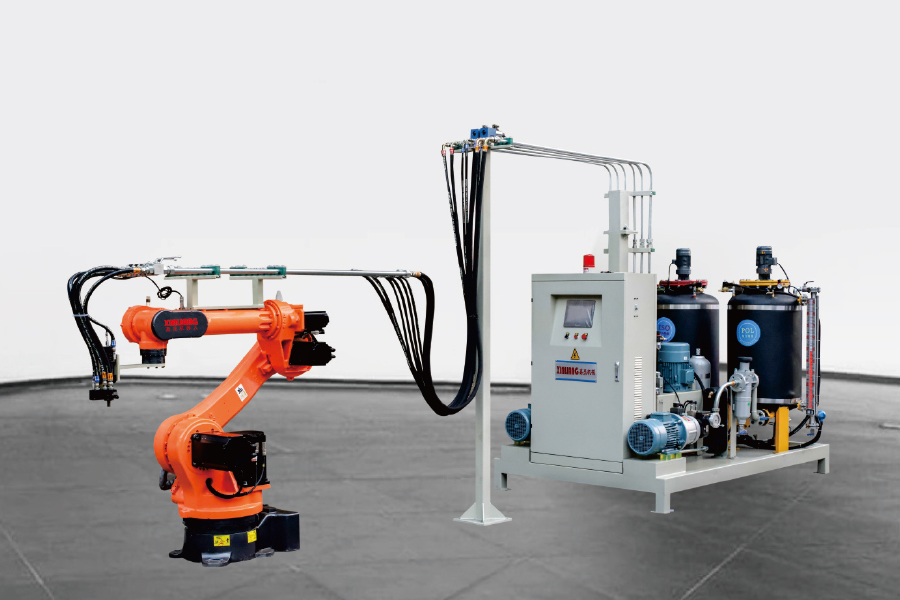
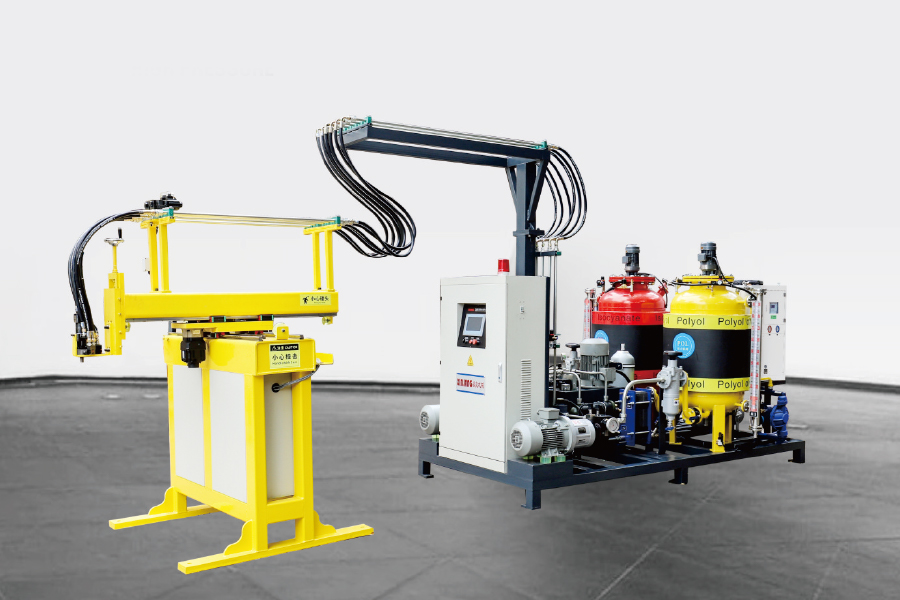
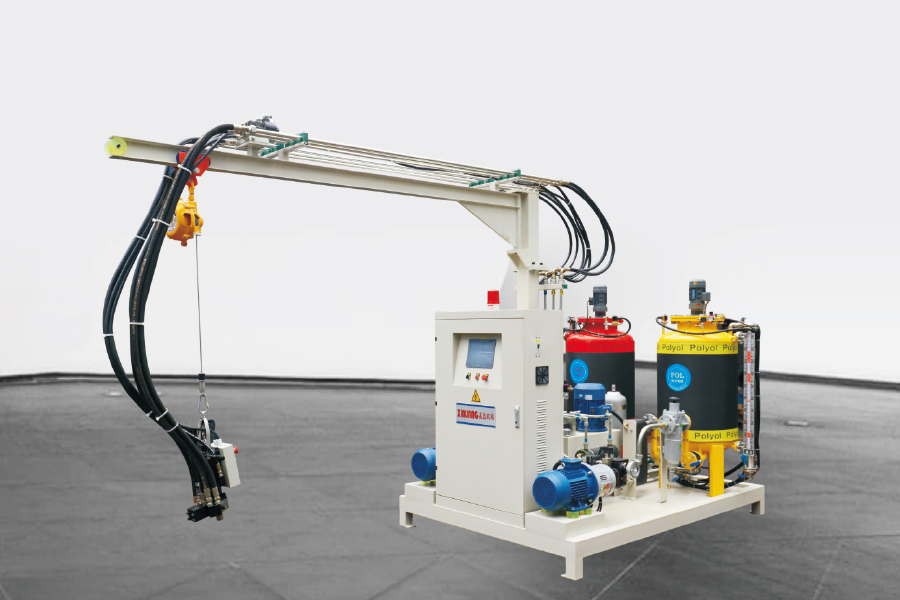
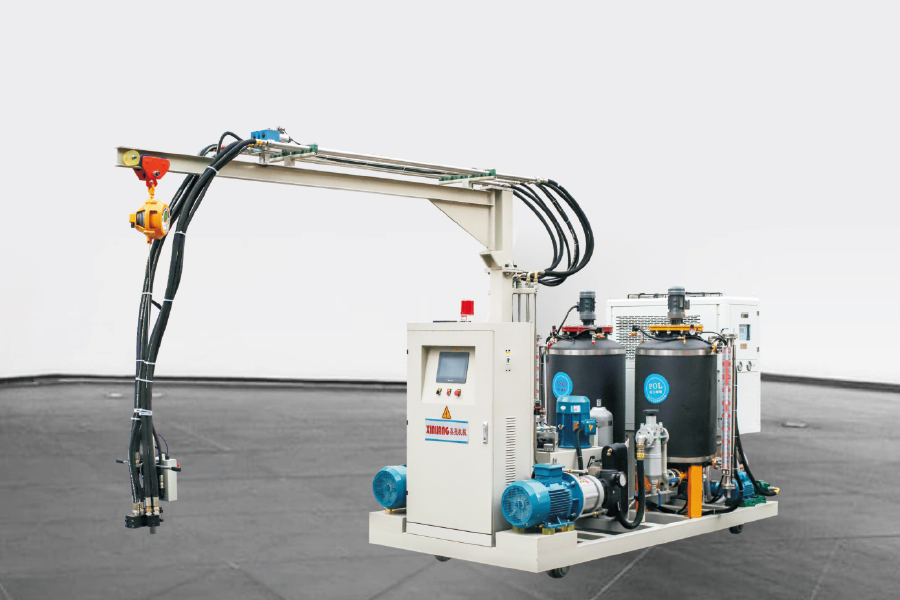
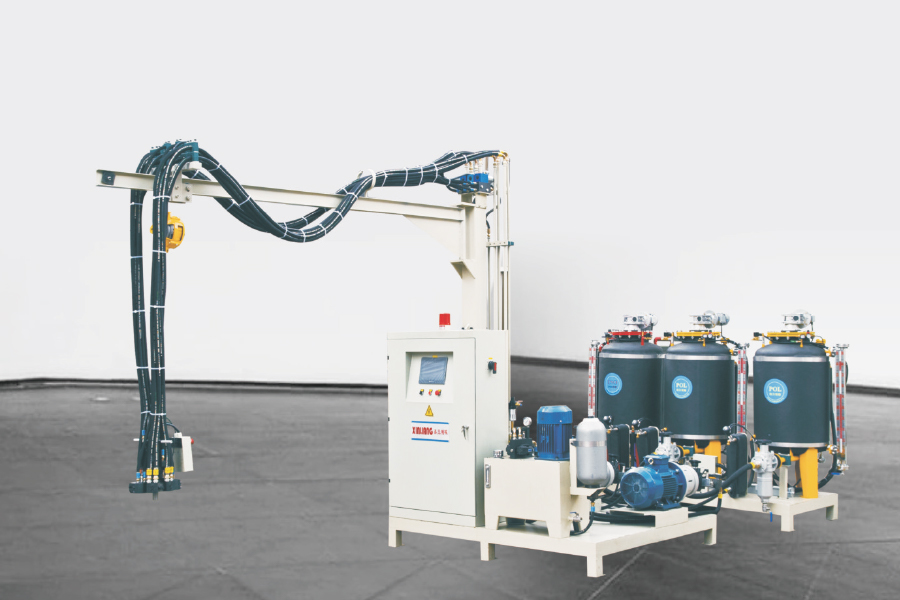
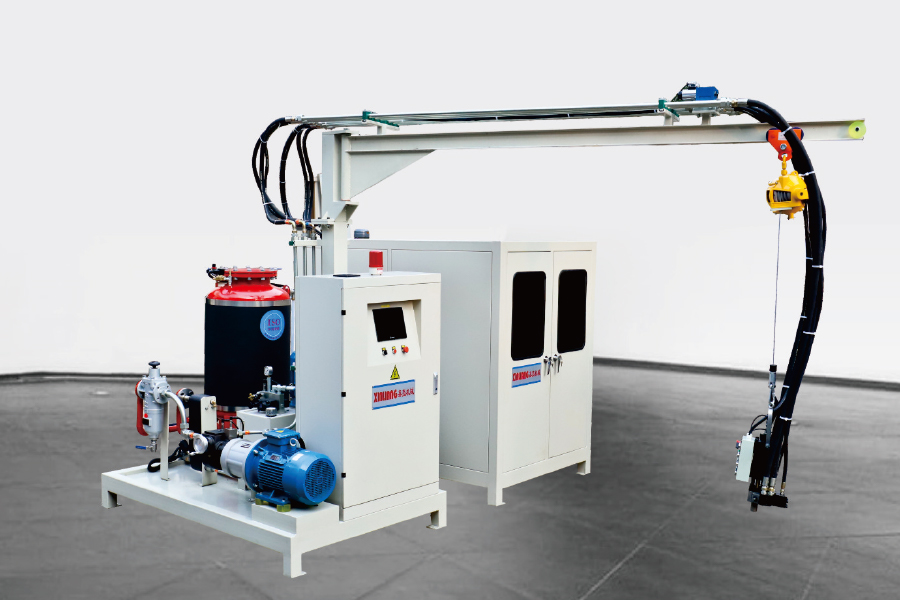
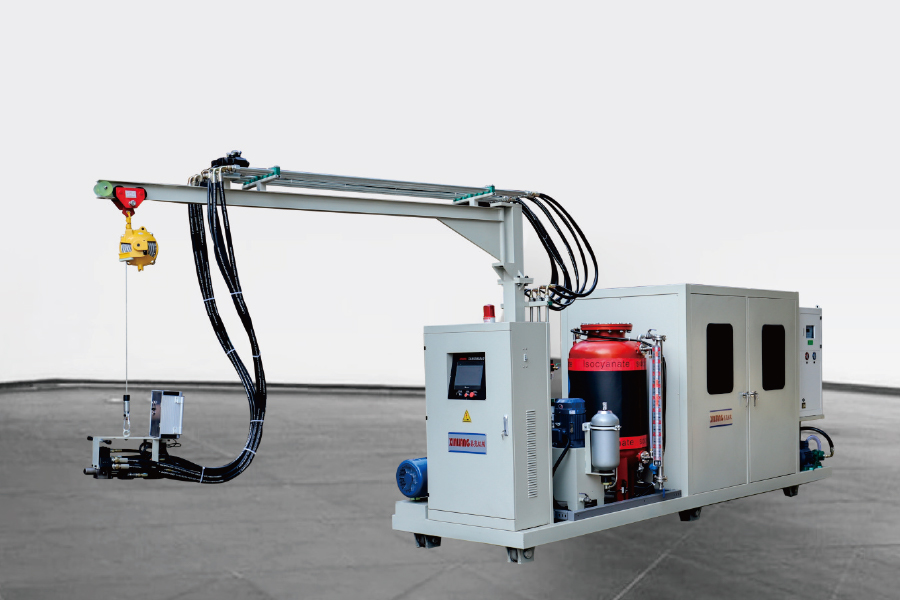
A polyurethane high pressure foaming injection machine operates by metering, pressurising, and impingement-mixing two reactive chemical components — typically polyol (Component A) and isocyanate (Component B) — at pressures ranging from 100 to 200 bar. At this pressure level, the two streams collide inside a compact mixing head at high velocity, achieving homogeneous mixing without a mechanical agitator. The mixed polyurethane formulation is then injected directly into a mould or dispensed onto a substrate where it expands and cures.
The high-pressure impingement mixing principle is fundamentally different from low-pressure mechanical mixing. Because mixing energy comes from the kinetic collision of the two streams rather than from a rotating mixer, the mixing head remains self-cleaning on each shot cycle — the pressurised recirculation of each component flushes residual material from the mixing chamber between shots, eliminating solvent cleaning and downtime associated with mechanical-mixer low-pressure machines.
Metering pumps: hydraulic or servo-driven piston pumps meter each component at a precisely controlled flow rate, determining the mix ratio and total shot weight
Mixing head: high-velocity impingement chamber with a hydraulically actuated cleaning piston — self-purging on each cycle without solvent
Recirculation circuit: components recirculate continuously through the system when the mixing head is closed, maintaining stable temperature and pressure between shots
Temperature control: independent heating/cooling circuits for each component tank and the mixing head maintain component temperatures within ±0.5 °C of the set point, which is critical for repeatable reactivity and foam density
The efficiency advantages of a polyurethane high pressure foaming injection machine over low-pressure or manual alternatives are measurable across four key production metrics: cycle time, material waste, part consistency, and labour requirement. The table below compares typical performance figures across the three process categories.
Performance Metric
Manual / Open Pour
Low-Pressure Machine
High Pressure PU Machine
Cycle Time per Shot
30 – 90 s
15 – 40 s
3 – 12 s
Mix Ratio Accuracy
±5 – 10%
±2 – 3%
±0.5 – 1%
Material Waste per Shift
8 – 15%
4 – 8%
1 – 3%
Part Density Variation
±10 – 20 kg/m³
±5 – 10 kg/m³
±1 – 3 kg/m³
Operators Required per Machine
2 – 4
1 – 2
0.5 – 1 (with automation)
Max Output Rate
1 – 3 kg/min
3 – 8 kg/min
10 – 25 kg/min
Cleaning Downtime per Shift
20 – 40 min
10 – 20 min
0 – 2 min
Table 1 — Comparative production performance metrics across manual, low-pressure, and high-pressure PU foaming processes. Values represent typical industry ranges.
Maximum Output Rate Comparison — PU Foaming Process Types (kg/min)
Manual / Open Pour
1 – 3
Low-Pressure Machine
3 – 8
High-Pressure PU Machine
10 – 25
Chart 1 — High-pressure foaming machines deliver up to 8× higher output rates than manual methods and 3× more than low-pressure systems.
A practical example illustrates the aggregate efficiency gain: a refrigerator panel insulation line using a high-pressure machine producing one shot every 5 seconds at 0.8 kg per shot delivers 576 kg of foam per hour in continuous operation — a volume that would require eight to ten manual operators to approximate, with inferior density consistency.
Why High Pressure Design Drives Efficiency: The Core Mechanisms
Self-Cleaning Mixing Head Eliminates Downtime
The most significant operational efficiency feature of a polyurethane high pressure foaming injection machine is the self-cleaning mixing head. After each shot, the hydraulic cleaning piston traverses the mixing chamber, mechanically ejecting residual mixed material before the next recirculation cycle purges the head with fresh component streams. This process takes less than 0.5 seconds and requires no solvent, no manual intervention, and no production stoppage. In a low-pressure mechanical mixer, head cleaning between formulation changes or at shift end requires solvent flushing, disassembly, and reassembly — consuming 10–30 minutes per cleaning event.
Precise Metering Reduces Material Waste
Servo-driven or hydraulic piston metering pumps in high-pressure systems control component flow rates with a precision of ±0.5–1% of set ratio. This accuracy directly reduces overuse of the more costly isocyanate component. In a production run consuming 500 kg of material per shift, a 3% reduction in material waste (compared to low-pressure methods) saves 15 kg of chemical per shift — a meaningful reduction in raw material consumption across high-volume production.
Consistent Mixing Quality Reduces Reject Rate
Impingement mixing at pressures above 100 bar produces homogeneous micro-mixing within the mixing chamber in less than 1 millisecond of contact time. This mixing quality is independent of operator skill, component viscosity variation, or temperature fluctuations — unlike mechanical mixing where mixing intensity varies with mixer speed, wear, and formulation. Consistent mixing translates directly to consistent foam cell structure, density, and mechanical properties, reducing part rejection rates from the 5–12% typical of manual or low-pressure processes to 0.5–2% in well-controlled high-pressure systems.
Integration with Automated Mould Handling
High-pressure machines are designed for integration with carousel mould systems, conveyor-based mould lines, robotic mould loaders, and automated demoulding equipment. The short shot time (3–12 seconds) and deterministic cycle timing of a high-pressure machine make it compatible with synchronised multi-station production cells where a single machine services multiple moulds in rotation. This architecture allows one machine to fill 8–16 moulds per minute in carousel configurations, maximising capital utilisation of both the foaming machine and the mould tooling.
Typical Part Rejection Rate by Foaming Process (%)
Manual / Open Pour
5 – 12%
Low-Pressure Machine
3 – 7%
High-Pressure PU Machine
0.5 – 2%
Chart 2 — High-pressure systems reduce part rejection rates by up to 85% compared to manual methods, directly improving yield per shift.
Industries Where High Pressure PU Foaming Machines Deliver the Greatest Gains
Automotive Seating and Interior Components
Automotive seat cushions, headrests, armrests, and instrument panel components are produced using polyurethane foaming machines for molding in high-volume injection moulding cells. A typical seat cushion production line operates at 180–240 shots per hour per machine, with tight density tolerances of ±2 kg/m³ required for consistent seat feel and durability compliance. High-pressure machines are the industry standard for this application because the mix ratio consistency and cycle speed required cannot be achieved by low-pressure alternatives at automotive production volumes.
Refrigeration and Cold Chain Insulation
Rigid polyurethane foam is the primary insulating material in refrigerators, freezers, cold room panels, and refrigerated transport containers. The polyurethane high pressure foaming injection machine injects pre-measured foam charges into the cavity between the inner liner and outer shell, where the foam expands and bonds to both surfaces. Precise shot weight control — typically within ±2 g per shot at 800 g average shot weight — ensures consistent insulation thickness and thermal performance across every unit. High-pressure systems achieve the void-free cavity filling required by energy efficiency regulations applied to refrigeration products in Europe, North America, and China in 2026.
Construction: Insulation Panels and Sandwich Boards
Continuous and discontinuous sandwich panel lines for building insulation use high-pressure foaming machines to deposit rigid foam between metal or fibre-reinforced facing sheets. Production speeds on continuous lines reach 6–12 m/min of finished panel, requiring foaming machines capable of sustained output rates of 15–25 kg/min with no interruption. The thermal conductivity of the resulting foam — typically 0.022–0.024 W/m·K — is directly dependent on cell structure uniformity, which is only achievable with impingement mixing at high pressure.
Footwear: Direct-Injection Sole Moulding
Polyurethane sole systems (single or multi-density) for athletic, safety, and casual footwear are produced on rotary carousel machines with 20–48 stations, using a polyurethane foaming machine for molding configured for rapid multi-component dispensing. A single carousel line can produce 800–1,200 pairs of soles per shift, with the high-pressure machine completing one injection per station as the carousel indexes. The low viscosity and fast reactivity of PU sole systems require the precise timing and mixing control that only high-pressure systems provide at this production rate.
Filtration and Technical Moulded Parts
Air filter housings, gaskets, vibration dampers, and technical elastomer parts produced from flexible or semi-rigid PU require precise void-free filling of complex mould geometries. High-pressure injection with carefully controlled back-pressure and injection speed ensures the foam front fills thin sections and undercuts without air entrapment. Shot weights in this segment are often small (50–300 g), and a custom PU foaming injection machine with a low-pressure-range metering configuration is frequently specified to achieve the required shot weight accuracy at the lower end of the machine's flow rate range.
How to Select the Right High Pressure PU Foaming Machine
Specifying the correct polyurethane high pressure foaming injection machine for a production application requires evaluation of the following parameters in sequence.
Output Rate and Shot Weight Range
Calculate the required output rate in kg/min based on the planned cycle time and average shot weight. Machine output capacity should be sized at 20–30% above the calculated peak demand to maintain stable recirculation pressure during continuous high-speed production. For small shot weights (under 100 g), confirm the machine's minimum shot weight specification — not all high-pressure machines maintain mix ratio accuracy at very low flow rates without a low-flow mixing head option.
Number of Components and Mix Ratio Range
Standard high-pressure machines process two components (polyol and isocyanate) at a fixed or adjustable ratio, typically in the range of 1:1 to 4:1 by weight. Applications requiring a third component (pigment, chain extender, fire retardant, or blowing agent) need a three- or four-component machine with an additional metering circuit. Confirm the required mix ratio range and whether the ratio must be adjustable during production (e.g., for multi-density sole systems) or can be fixed at commissioning.
Component Temperature Control Requirements
Polyol components typically require processing temperatures of 20–35 °C; isocyanate is sensitive to temperature above 40 °C (crystallisation risk). Confirm the precision of the machine's temperature control system — a specification of ±0.5 °C is standard for quality-sensitive applications. For materials with narrow processing windows (specialty formulations, low-index systems), tighter control or additional heat exchangers at the mixing head may be required.
Mixing Head Type and Mould Integration
Mixing head selection depends on the mould type and production geometry. L-shaped heads suit open mould filling; straight or angled high-pressure heads suit closed-mould injection through a sprue. For robotic dispensing or traversing gantry dispensing, the mixing head must be compatible with the robot mounting interface and have a short purge cycle to maintain quality at start-up. Confirm whether the machine supplier offers a custom PU foaming injection machine configuration with the specific mixing head and robot interface required for your production cell.
Control System and Data Logging
Modern high-pressure foaming machines operate under PLC control with HMI touchscreens, programmable shot recipes, real-time pressure and flow monitoring, and production data logging. For quality management systems (ISO 9001, IATF 16949), the ability to log shot weight, mix ratio, component temperature, and injection pressure per shot is a regulatory requirement. Confirm that the machine's control system exports data in a format compatible with the facility's MES or ERP system.
Selection Parameter
Typical Range / Specification
Key Consideration
Output Rate
0.5 – 25 kg/min
Size at 120–130% of peak demand
Injection Pressure
100 – 200 bar
Higher pressure improves mixing for low-viscosity systems
Mix Ratio Range
1:1 to 4:1 (weight)
Multi-density or pigmented systems need adjustable ratio
Temperature Control Accuracy
±0.5 °C
Critical for consistent reactivity and foam density
Shot Weight Accuracy
±1 – 2 g per shot
Verify at minimum and maximum shot weight settings
Component Tanks
50 – 1,000 L
Size for minimum 4 hours of uninterrupted production
Number of Components
2 – 4
3- or 4-component for pigmented or specialty formulations
Table 2 — Key selection parameters for a polyurethane high pressure foaming injection machine. Confirm all specifications against the actual formulation and production cycle requirements.
When a Custom PU Foaming Injection Machine Is the Right Choice
Standard high-pressure machines cover the majority of common production requirements. However, a custom PU foaming injection machine becomes necessary when the application has requirements outside the standard product range. The following scenarios typically require a custom specification:
Multi-component formulations: systems using a third or fourth component (flame retardant additive, colorant, auxiliary blowing agent) require additional metering circuits that must be integrated into the machine design from the outset
Unusual mix ratios: formulations with weight ratios outside the standard 1:1–4:1 range (e.g., high-index isocyanate systems at 6:1 or above) require custom pump sizing and pressure balancing to maintain mix quality
Robotic and gantry integration: production cells where the mixing head is mounted on a 6-axis robot or linear gantry require a machine architecture with a remote mixing head, extended high-pressure hose bundle, and synchronised PLC-to-robot communication interface
Hygienic or cleanroom environments: pharmaceutical insulation, medical device packaging, and food-contact foam applications may require stainless steel wetted components, HEPA-filtered ventilation, and IP65-rated electrical enclosures
Very high or very low output rates: applications below 0.3 kg/min (precision technical parts) or above 25 kg/min (large continuous panel lines) typically require custom metering pump sizing that falls outside standard catalogue specifications
When requesting a custom PU foaming injection machine, provide the formulation system (polyol type, isocyanate index, blowing agent, additives), target shot weight and cycle time, mould type and clamping force, required mix ratio, and integration requirements (robot interface, MES connectivity, safety zone requirements). This information allows the machine builder to correctly specify all subsystems before engineering begins.
Maintenance Requirements and Long-Term Reliability
Sustained production efficiency from a polyurethane high pressure foaming injection machine depends on consistent preventive maintenance. The high-pressure hydraulic system, precision metering pumps, and mixing head are the three subsystems that require the most attention.
Mixing head: inspect cleaning piston seal condition every 200,000–500,000 shots depending on formulation abrasiveness; replace O-rings and wear sleeves on schedule to maintain self-cleaning effectiveness
Metering pumps: check pump pressure balance and flow calibration every 500 operating hours; recalibrate flow meters against gravimetric measurements to confirm mix ratio accuracy
Hydraulic system: change hydraulic fluid and filter elements every 2,000 operating hours or annually; inspect high-pressure hose assemblies for wear at the mixing head connection point
Temperature control system: flush heat exchanger circuits annually to prevent scale build-up that reduces temperature control precision; verify thermocouple calibration against reference thermometer
Component tanks: inspect for isocyanate crystallisation on internal surfaces and agitator seals quarterly; flush with approved solvent if crystallisation is detected to prevent contamination of the metering system
A well-maintained high-pressure foaming machine operating in a two-shift production environment has a typical service life of 15–20 years before major overhaul of the hydraulic power unit and metering pumps is required. The mixing head assembly, being a wear item, is typically rebuilt or replaced every 3–7 years depending on production volume and formulation aggressiveness.
Frequently Asked Questions
A polyurethane high pressure foaming injection machine completes one shot cycle in 3–12 seconds, compared to 30–90 seconds for a skilled manual operator. In continuous carousel production, a single high-pressure machine can service 8–16 moulds per minute, delivering output rates of 10–25 kg of foam per minute — typically 6–8 times higher than manual processes at equivalent mould size. This cycle time advantage compounds over a full production shift to deliver significantly higher parts output per unit of floor space and capital investment.
High-pressure machines mix polyol and isocyanate by impingement — two streams collide at 100–200 bar inside the mixing chamber, achieving mixing without a mechanical agitator. The mixing head is self-cleaning on each cycle. Low-pressure machines use a mechanical rotating mixer at 2–20 bar to blend the components, and require solvent flushing to clean the mixer between formulation changes or at end of shift. High-pressure systems offer better mixing quality, shorter cycle times, no solvent consumption, and higher output rates; low-pressure systems have lower capital cost and are suited to smaller-volume or less time-critical applications.
Yes. The same high-pressure machine platform can process both rigid and flexible polyurethane foam formulations by changing the component materials loaded into the tanks and adjusting the mix ratio, temperature, and injection parameters accordingly. However, the optimal mixing head geometry and injection pressure may differ between rigid and flexible systems. A polyurethane foaming machine for molding configured for both product types should be specified with an adjustable mix ratio range, swappable mixing head options, and independent temperature control capable of covering the processing temperature requirements of both formulation types.
Mix ratio accuracy in a high-pressure system is maintained by the precision metering pumps — typically servo-driven piston pumps with feedback-controlled stroke length — and verified continuously by real-time flow measurement sensors on each component circuit. Modern machines log the actual delivered ratio for every shot and trigger an alarm if the ratio deviates beyond a set tolerance (typically ±1%). Periodic gravimetric calibration checks (weighing the actual output from each pump circuit at a set flow command) confirm that the electronic measurement matches physical delivery. This calibration is recommended every 500 operating hours.
A custom PU foaming injection machine is most appropriate when the production requirements fall outside standard catalogue specifications — for example, three- or four-component formulations requiring additional metering circuits, robotic mixing head integration for complex mould geometries, hygienic stainless-steel construction for food-contact or pharmaceutical applications, unusually high or low output rate requirements, or mix ratios outside the standard 1:1–4:1 range. Custom configurations also benefit OEM machine builders integrating the foaming machine into a purpose-built production cell where the standard machine footprint or I/O interface is not compatible with the cell layout.
With regular preventive maintenance, a high-pressure PU foaming machine operating in a two-shift production environment has a typical service life of 15–20 years. Key maintenance intervals include: mixing head seal inspection every 200,000–500,000 shots, metering pump calibration every 500 operating hours, hydraulic fluid and filter change every 2,000 hours, and annual heat exchanger flushing. The mixing head assembly is a consumable item rebuilt every 3–7 years depending on production intensity. Maintaining a stock of mixing head wear parts (seals, cleaning piston sleeves, nozzle inserts) is recommended to minimise unplanned downtime.


 English
 русский
 عربى
عربى