Home / News / Industry news / Blowing Agent Guide: Types, Selection Criteria, and Polyurethane Foam Applications
Blowing Agent Guide: Types, Selection Criteria, and Polyurethane Foam Applications
Industry news-
When a polyurethane insulation panel comes off the line with a spongy core, uneven density, and thermal conductivity creeping above specification, the formulation is usually the first suspect. Within it, the most influential variable is the blowing agent. It determines cell size, density, insulation value, dimensional stability, and long-term performance. This guide explains what blowing agents do, how physical and chemical types differ, why cyclopentane now dominates appliance foams, and what equipment choices follow.
A blowing agent is a substance that generates gas within a polymer matrix during the foaming process, creating the cellular structure of the foam. In rigid polyurethane, that gas is trapped in closed cells and becomes the main contributor to insulation performance. Blowing agents work in two ways:
Physical blowing agents are low-boiling liquids that vaporize under the heat released by the isocyanate-polyol reaction. Cyclopentane, n-pentane, HFC-245fa, and HFO-1234ze(E) are common examples.
Chemical blowing agents generate gas through a chemical reaction or decomposition. Water reacts with isocyanate to release carbon dioxide; azo compounds decompose to release nitrogen and other gases.
Most rigid polyurethane foam used in refrigeration and building panels relies primarily on a physical blowing agent, with a small amount of water-blown CO2 used to fine-tune cell morphology.
Physical vs. Chemical Blowing Agents: What Changes in Practice
The choice between a physical and a chemical blowing agent is not purely chemical. It determines metering, mixing, curing, and the type of equipment the line needs. The table below summarizes the differences that matter on a production floor.
Behavioral differences between physical and chemical blowing agents in rigid PU foam
Property
Physical (cyclopentane)
Chemical (water/CO2)
Gas generation mechanism
Evaporation from liquid phase
Reaction with isocyanate
Cell morphology
Fine, predominantly closed cells
More open cells, coarser texture
Blowing efficiency per unit mass
High (low molecular weight vapor)
Moderate (limited by CO2 solubility)
Handling risk
Flammable; requires explosion-proof line
Non-flammable; simpler storage
Typical role in formulation
Primary agent for insulation
Co-agent for density adjustment
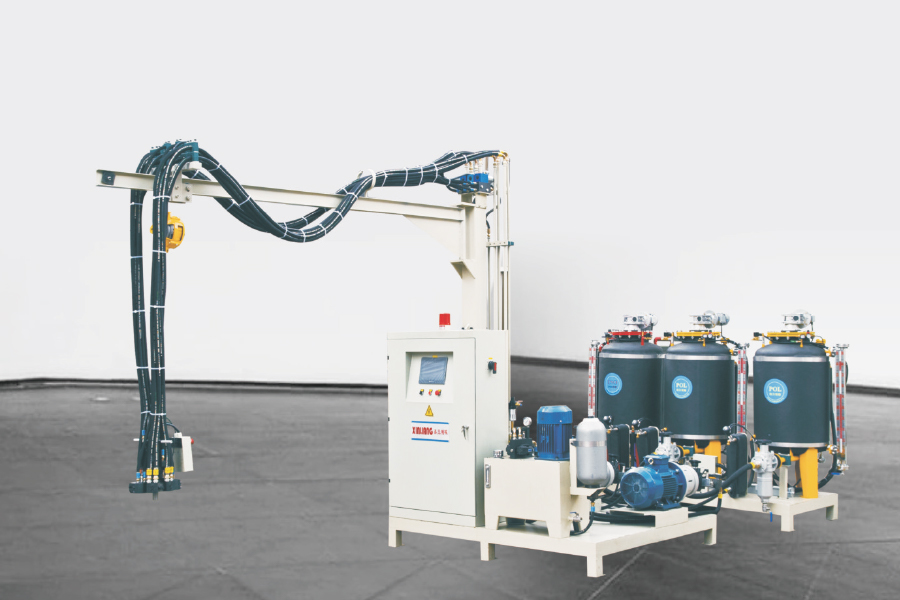
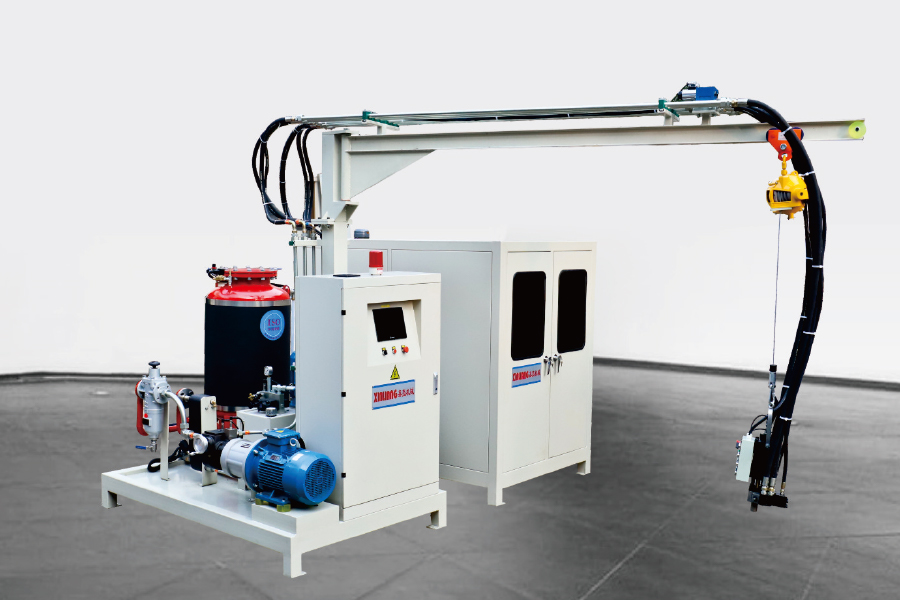
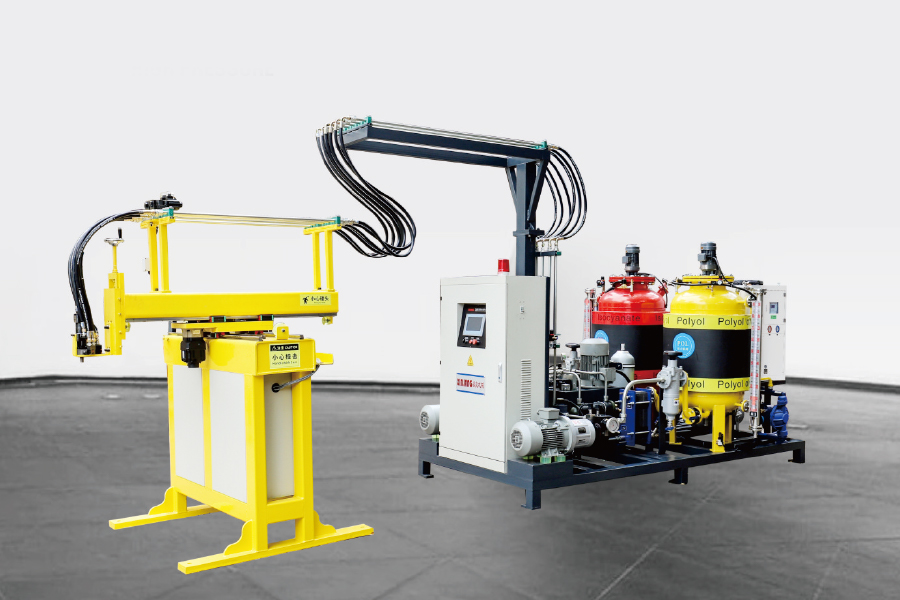
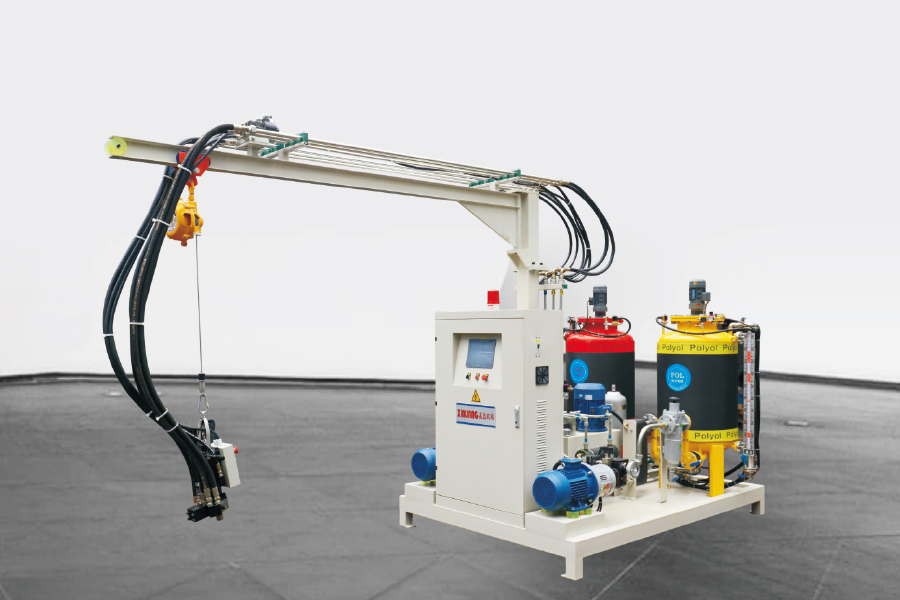
When a formulation needs a separate blowing-agent stream, or when polyol, isocyanate, and a third additive such as a flame retardant must be combined, a three-component high-pressure injection machine is the most predictable solution. Each stream is metered independently and meets only in the mixing chamber at the moment of injection, which minimizes pre-reaction and improves shot-to-shot repeatability.
No single blowing agent fits every product. The right choice balances thermal performance, process stability, regulatory exposure, and cost. These criteria regularly shape procurement decisions:
Gas-phase thermal conductivity. Lower conductivity in the trapped gas improves insulation value. Cyclopentane vapor conducts roughly 0.013 W/mK, notably less than air at about 0.026 W/mK.
Solubility in the polyol blend. The agent must stay uniformly dispersed from the premix tank to the mixing head. Poor solubility causes cell-size variation and density drift.
Boiling point. A physical agent should vaporize when the reaction exotherm peaks, typically 60-90 °C inside the foam core. Cyclopentane's boiling point of about 49 °C fits this window well.
Environmental credentials. Ozone depletion potential (ODP) and global warming potential (GWP) determine whether the foam can be sold into markets with strict environmental rules.
Safety integration. Flammable agents demand explosion-proof electrical design, gas monitoring, inert-gas blanketing, and specific handling procedures.
Economics. Agents are compared not by price per kilogram alone, but by the cost per unit volume of foam at the required density and insulation target.
In industrial foam production, the practical trade-off usually comes down to insulation performance versus processing convenience and regulatory pressure.
Why Cyclopentane Became the Default for Appliance Foam
The phase-out of chlorofluorocarbons under the Montreal Protocol pushed the polyurethane industry through several generations of blowing agents. HCFC-141b was a transitional replacement, followed by HFCs, and the market is now consolidating around hydrocarbons, mainly cyclopentane, plus HFO blends. According to the IPCC Fifth Assessment Report, the 100-year global warming potential of the key agents tells a clear story:
Global Warming Potential (100-year) by Blowing Agent
CFC-11
4,660
HCFC-141b
782
HFC-245fa
858
Cyclopentane
11
HFO-1234ze
<1
Source: IPCC AR5 values. Cyclopentane and HFO bars are drawn at minimum width to remain visible on the linear scale.
Cyclopentane offers a GWP generally cited as about 11, zero ODP, good solubility in polyols, and low vapor-phase thermal conductivity. That combination makes it highly effective in refrigerator, freezer, and insulation-panel lines. HFO-1234ze reaches even lower GWP, but its cost and formulation differences have kept it in premium segments so far.
Switching to cyclopentane is not just a formulation change. Because cyclopentane is flammable, with a lower explosive limit of about 1.4% by volume in air, the entire handling and foaming system must be designed to prevent ignition. That includes sealed mixing heads, nitrogen-purged storage, and gas detection on the line.
How Blowing Agent Content Affects Foam Density and Structure
The most direct relationship in foam formulation is between blowing agent content and foam density. More agent generates more gas, expanding the polymer further before it cures. Density falls quickly at first, then levels off as cell structure becomes the limiting factor.
Rigid Foam Density vs. Blowing Agent Content
Illustrative curve based on typical rigid polyurethane formulation guidelines; exact values depend on the polyol system.
Beyond a certain concentration, typically in the 25-30 parts per 100 parts polyol range, additional blowing agent no longer lowers density. Instead, it can enlarge cells unevenly, weaken cell walls, and raise thermal conductivity. That is why producers tune the formulation around a target density rather than simply adding more agent.
The internal structure determines insulation quality. In the cutaway view below, each polyurethane cell wall encloses a pocket of blowing-agent vapor. If that gas diffuses out of the finished foam and air diffuses in, the insulation value gradually declines, a phenomenon known as thermal conductivity aging.
Cutaway View of Rigid Polyurethane Foam Cells
Schematic cutaway; cell concentration and dimensions are not to scale.
Good cell regularity is therefore not cosmetic. It keeps thermal-conductivity aging slow and predictable, which is what customers actually measure over the life of an appliance or panel.
Equipment Considerations for Blowing Agent Processing
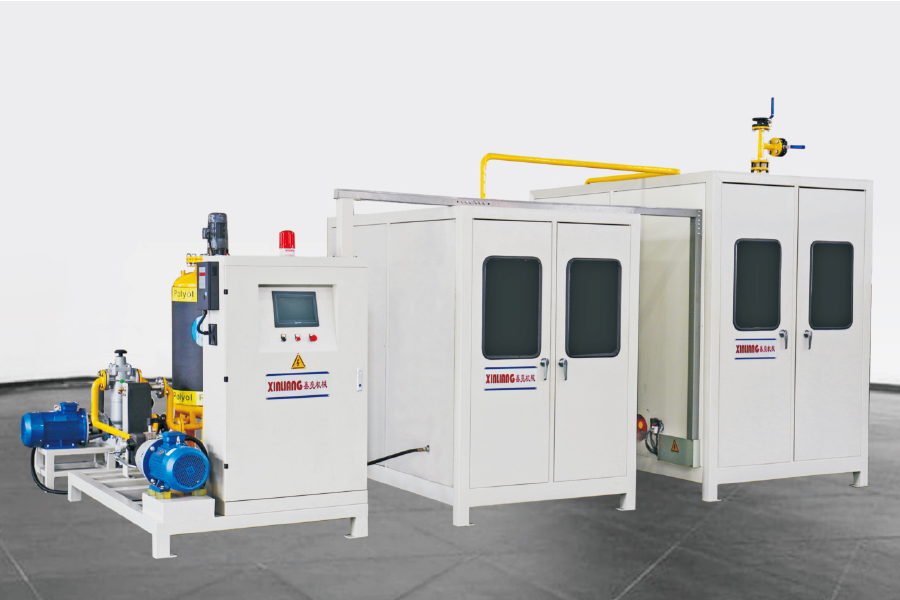
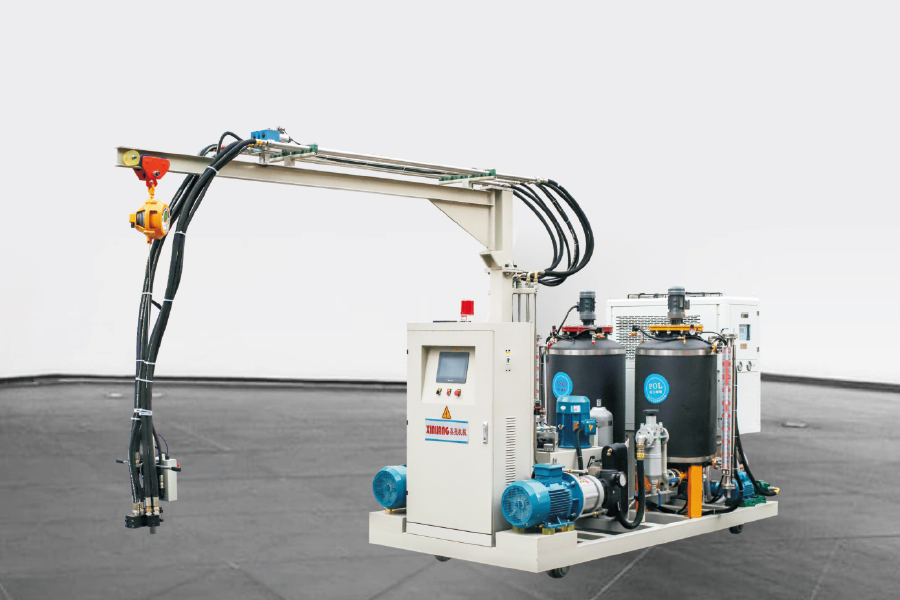
Blowing agents enter the foam process either pre-blended into the polyol or dosed as a separate stream at the mixing head. For cyclopentane, premixing is the most widespread method because it keeps the agent uniformly dispersed and simplifies the metering task at the injection unit. A dedicated cyclopentane premix system blends the hydrocarbon with polyol under a nitrogen blanket, holds the mix at the correct temperature, and supplies a stable concentration to the foaming machine.
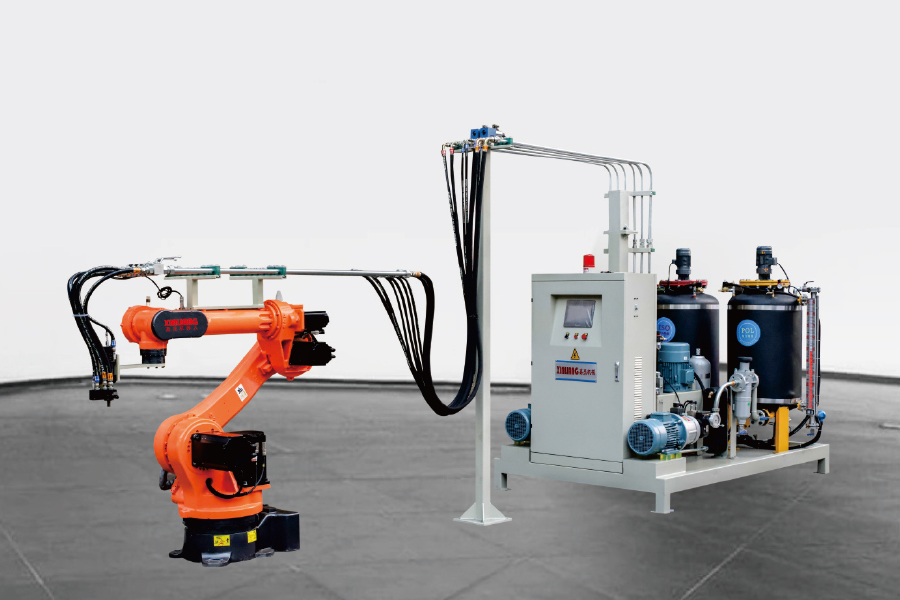
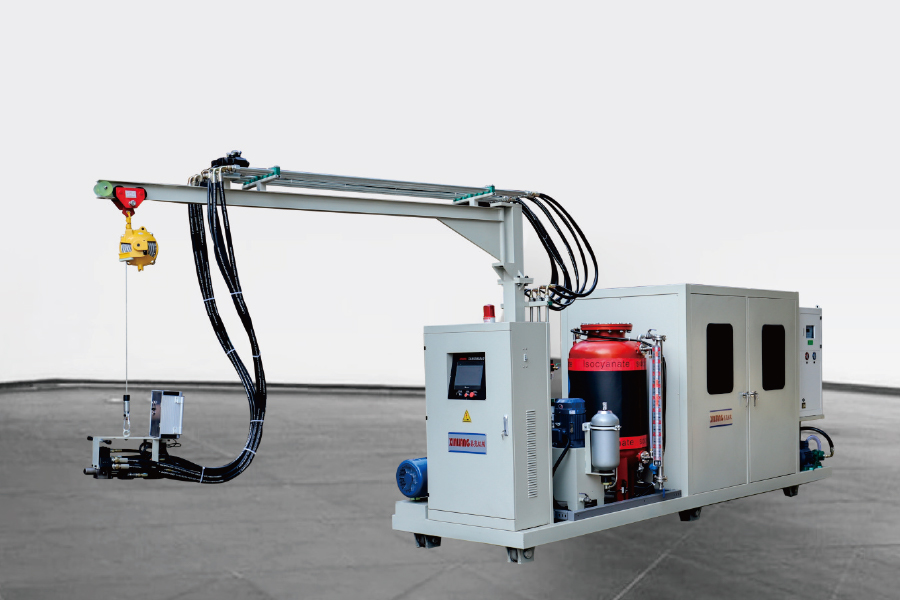
High-pressure foaming machines operating with hydrocarbon blowing agents must be rated for flammable service. Sealed mixing heads, explosion-proof electrical enclosures, proper bonding and grounding, and automatic shutdown on gas detection are fundamental requirements. The same machines also need precise ratio control, because cyclopentane dosing variations of more than a few tenths of a part directly change density and dimensions.
For producers who want to keep the blowing agent separate from the polyol until the last possible moment, or who need to inject a third component such as a flame retardant, a three-component high-pressure machine is the practical choice. Independent pumps and control loops allow each stream to be calibrated and adjusted without disturbing the others.
Beyond the blowing agent itself, the process parameters that most affect foam consistency are material temperature, mixing pressure, and the polyol-to-isocyanate ratio. These are where equipment quality shows up in daily production.
Blowing Agent Questions Buyers Actually Ask
Q1. What is a blowing agent in polyurethane?
A blowing agent is a substance that produces gas during foaming, creating the cell structure of polyurethane. Physical types like cyclopentane evaporate under reaction heat; chemical types like water react with isocyanate to release CO2.
Q2. Is cyclopentane flammable?
Yes. Cyclopentane has a lower explosive limit of about 1.4% by volume in air. Handling requires explosion-proof equipment, nitrogen purging, and continuous gas monitoring.
Q3. Which is better: physical or chemical blowing agent?
For insulation, physical agents generally produce finer closed cells and lower thermal conductivity. Chemical agents like water are used as co-blowing agents to adjust density and reduce cost.
Q4. Why is cyclopentane used in refrigerator insulation?
Cyclopentane combines low GWP (about 11), zero ODP, good polyol solubility, and low vapor thermal conductivity, making it one of the most cost-effective low-GWP insulation solutions for appliances.
Q5. How much blowing agent does a rigid foam formulation need?
A typical rigid formulation uses 10-15 parts of cyclopentane per 100 parts of polyol, often with 1-3 parts of water. The exact amount depends on target density and mixing efficiency.
Q6. What is the GWP of cyclopentane vs. HFC-245fa?
Cyclopentane has a GWP of about 11; HFC-245fa has a GWP of about 858. Switching to cyclopentane cuts the direct CO2-equivalent contribution of the foam by roughly 98%.


 English
 русский
 عربى
عربى