Home / News / Industry news / Polyurethane High Pressure Foaming Machine: Complete Buyer's Guide 2026
Polyurethane High Pressure Foaming Machine: Complete Buyer's Guide 2026
Industry news-
A polyurethane high pressure foaming machine is a precision industrial system that mixes isocyanate (MDI/TDI) and polyol components under pressures typically ranging from 100 to 200 bar, enabling high-throughput foam production for insulation panels, refrigeration equipment, automotive parts, and more. Unlike low-pressure systems, high-pressure mixing heads generate intense turbulence that eliminates the need for mechanical agitation, resulting in more uniform cell structures and faster reaction cycles. If you are evaluating equipment for a production upgrade or new line, this guide delivers actionable technical insight, performance benchmarks, and selection criteria to help you make a well-informed decision.
Ningbo Xinliang Machinery Co., Ltd. is an enterprise combining industry and trade, dedicated to producing polyurethane foaming equipment, polyurethane foaming production lines, and cyclopentane polyurethane foaming complete equipment. With more than ten years of R&D experience and a deep understanding of both domestic and international advanced technologies, Xinliang provides customized solutions tailored to the specific requirements of the polyurethane industry.
What Is a Polyurethane High Pressure Foaming Machine?
A polyurethane high pressure foaming machine (also called a high pressure PU machine or PU injection machine) is a metering and mixing device that delivers two or more reactive chemical components — typically a polyol blend and an isocyanate — at precisely controlled ratios and pressures. The components collide at high velocity inside a self-cleaning mixing head, initiating a rapid exothermic reaction that produces polyurethane foam.
The defining characteristic of high-pressure systems is the impingement mixing mechanism. At pressures above 100 bar, the raw streams impinge at velocities exceeding 100 m/s, creating turbulent mixing without any rotating parts in the mix chamber. This self-cleaning action prevents residue buildup and dramatically reduces maintenance downtime compared to low-pressure alternatives.
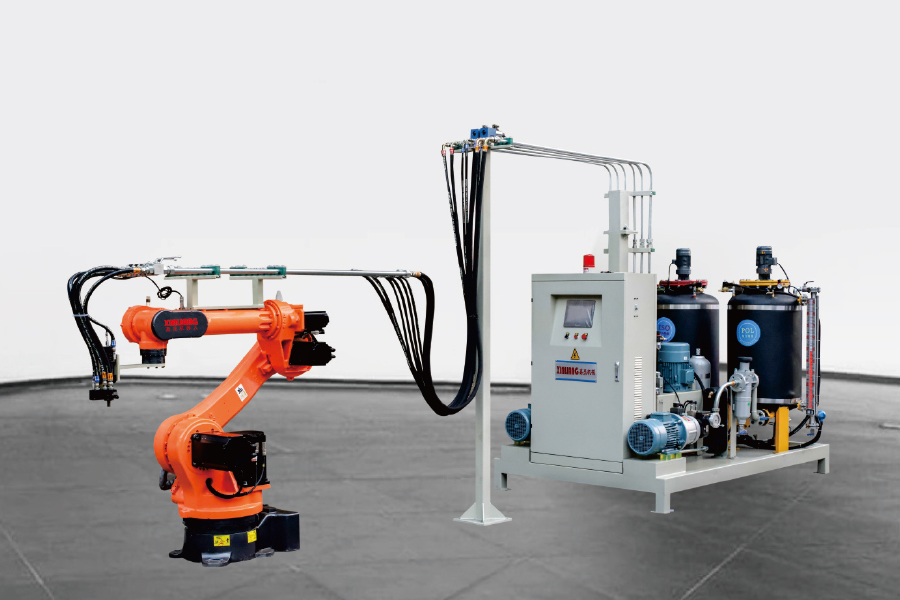
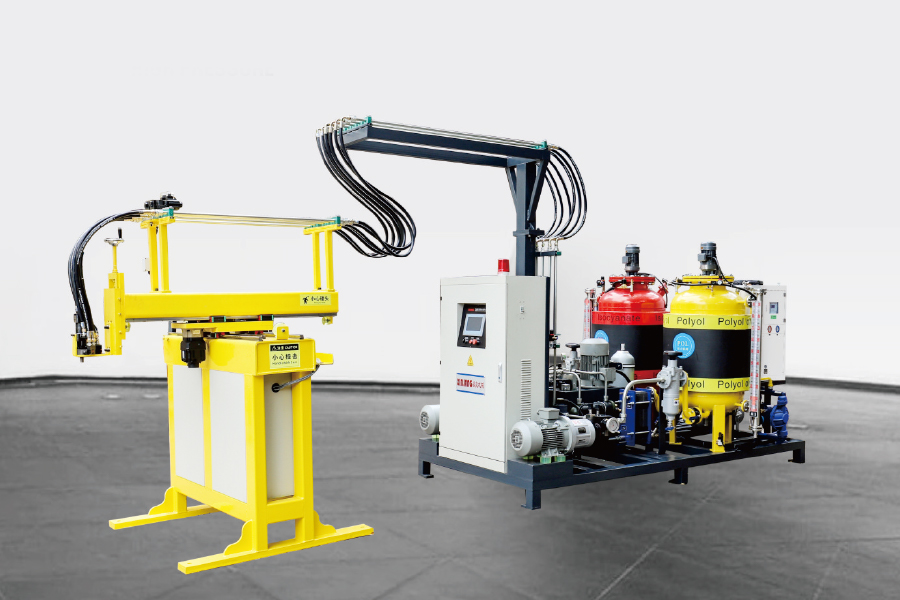
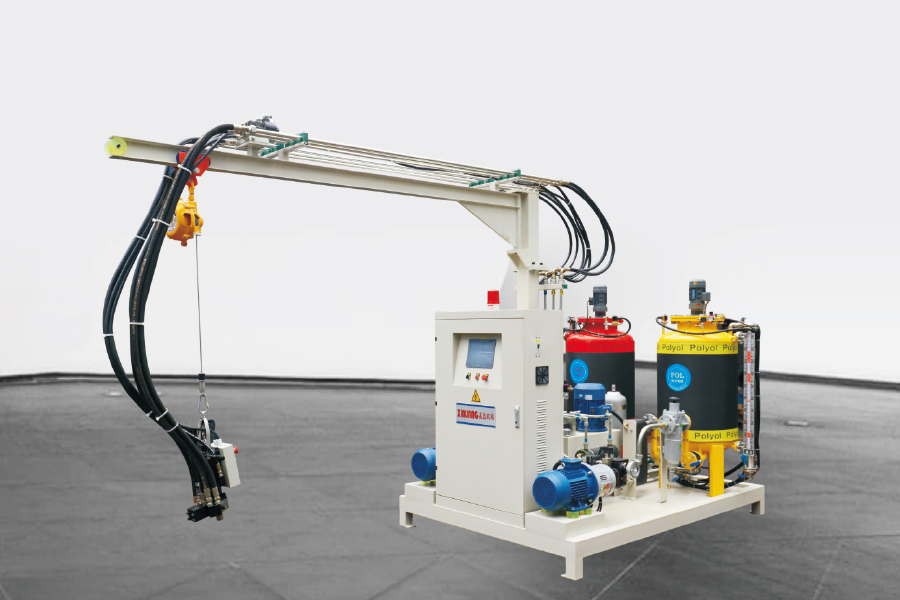
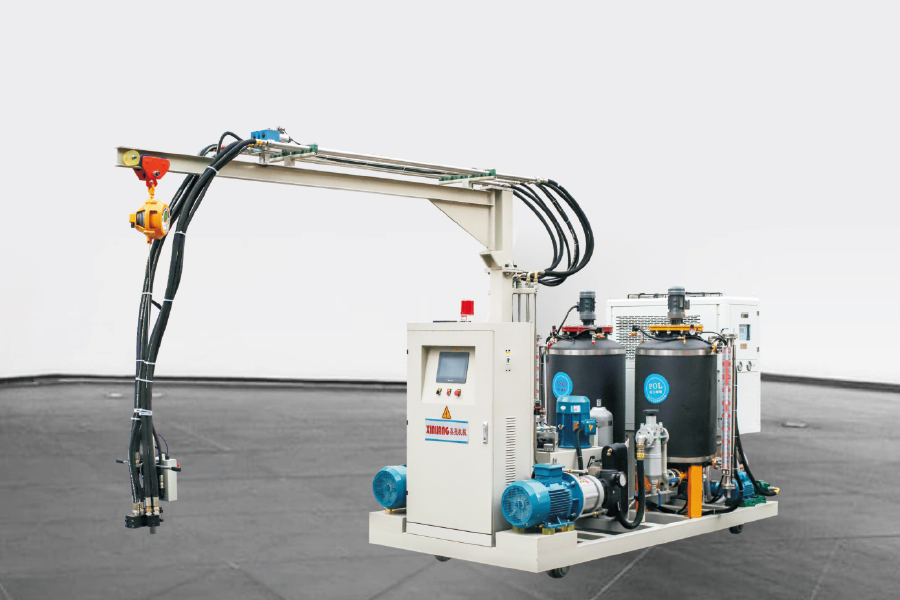
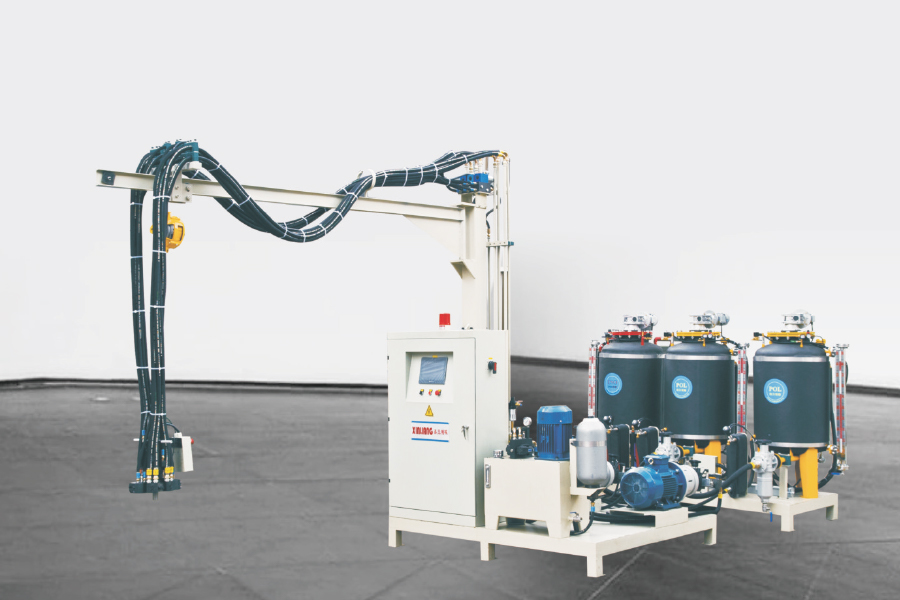
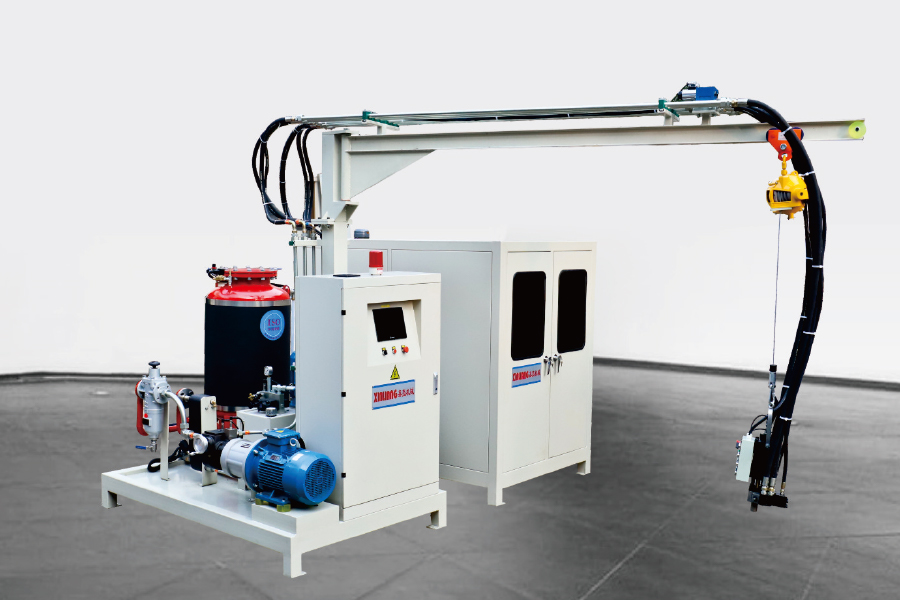
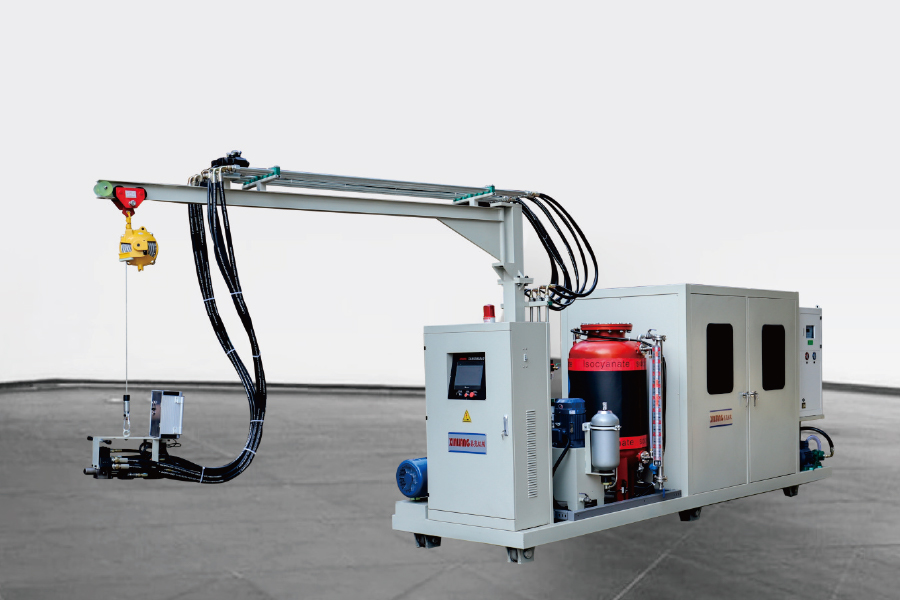
Key sub-systems include high-precision metering pumps, temperature-controlled storage tanks, a programmable PLC control unit, hydraulic or pneumatic actuators for the mixing head, and a conveying or mold system depending on the application. Modern fully automatic PU foaming machines integrate all these elements into a unified, digitally controlled production cell.
Figure 1: High-pressure PU foaming systems deliver significantly higher mixing pressure, output rate, and foam cell uniformity compared to conventional low-pressure alternatives. The self-cleaning mixing head design also translates to lower maintenance frequency. These performance advantages make high-pressure systems the preferred choice for industrial-scale polyurethane foam production lines.
High-Pressure vs Low-Pressure PU Foaming: Core Technical Differences
Selecting between high-pressure and low-pressure foaming technology is one of the most consequential decisions when investing in polyurethane foam equipment. The two approaches differ fundamentally in mixing mechanism, output capacity, material compatibility, and total cost of ownership.
Table 1: Technical comparison between high-pressure and low-pressure polyurethane foaming machines across key production parameters
Parameter
High-Pressure System
Low-Pressure System
Operating Pressure
100–200 bar
5–20 bar
Mixing Method
Impingement (no moving parts)
Mechanical agitator
Output Range
5–100+ kg/min
0.5–10 kg/min
Self-Cleaning
Yes (hydraulic purge)
No (manual solvent flush)
Foam Density Range
8–600 kg/m³
20–200 kg/m³
Component Ratio Accuracy
±0.5%
±2–5%
Suitable Applications
Insulation panels, automotive, cold-chain
Small parts, crafts, low-volume runs
High-pressure impingement mixing produces significantly better mixing homogeneity. Research published in the Journal of Cellular Plastics (Vol. 58, 2022) confirms that impingement-mixed systems yield foam with closed-cell content exceeding 90%, compared to 70–80% for mechanically mixed formulations under equivalent conditions. This directly translates to better thermal insulation values (lower lambda coefficient) and superior mechanical strength.
For manufacturers investing in a polyurethane machine for insulation panel production or a continuous polyurethane foaming machine for sandwich panels, high-pressure technology is the industry-standard choice. Low-pressure machines remain viable for laboratory prototyping or niche applications where throughput demands are modest.
Industries and Applications Driving Global Demand
The global market for industrial polyurethane foaming machines continues to expand, driven by construction energy efficiency standards, cold-chain logistics growth, and automotive lightweighting trends. According to MarketsandMarkets (2023), the global PU foam market is projected to reach USD 98.4 billion by 2028, growing at a CAGR of approximately 5.8%. This growth directly fuels investment in advanced foaming equipment across multiple verticals.
Figure 2: The construction and building insulation sector accounts for the largest share of PU foaming machine usage globally, followed by refrigeration and cold-chain logistics. Automotive and furniture industries are also major consumers, while emerging applications in marine, aerospace, and medical sectors contribute to the "Other" category. This distribution reflects the growing regulatory push for energy-efficient building envelopes and cold chain integrity worldwide.
Building Insulation and Sandwich Panel Production
The largest single application for high pressure PU foam equipment is the production of insulated sandwich panels for commercial and industrial construction. These panels, which feature steel or aluminum facings bonded to a rigid PU foam core, are produced on continuous polyurethane foaming machines running at line speeds of 3–12 m/min. Foam density in this application typically ranges from 38–45 kg/m³, with thermal conductivity values (lambda) of 0.022–0.024 W/(m·K).
Refrigeration and Cold Chain Equipment
Domestic and commercial refrigerators, freezer cabinets, refrigerated trucks, and cold storage rooms all rely on in-situ PU foam injection to fill cavities between cabinet walls. This application demands the highest precision — density deviations of more than ±1 kg/m³ can cause structural failure or thermal bridging. A fully automatic PU foaming machine with servo-controlled metering pumps is essential for this quality-critical segment.
Automotive and Transportation Components
Seat cushions, headrests, door panels, steering wheels, and acoustic insulation for vehicles are produced using automatic polyurethane injection machines configured for open or closed molds. The automotive sector demands short cycle times (often under 4 minutes), precise shot weights (accuracy ±0.5%), and multi-component capability to switch between different formulations without line stoppages.
Critical Technical Specifications to Evaluate
When sourcing from a high pressure PU foaming machine manufacturer, understanding the specification sheet in depth is essential. Here are the parameters that most directly affect production quality and operational cost:
Metering Accuracy and Flow Range
The metering system controls the volumetric or mass flow of each component. High-quality high-pressure metering systems achieve ratio accuracy of ±0.5% or better, which is critical because even a 2% deviation in the isocyanate index (NCO/OH ratio) causes measurable changes in foam density, open-cell content, and compressive strength. Gear pumps, piston pumps, and variable-displacement axial-piston pumps each have different accuracy profiles; modern systems increasingly use servo-driven piston pumps for highest precision.
Output Rate and Shot Weight
Output is expressed in kg/min (total mixed output) or g/shot for intermittent applications. Industrial systems range from 5 kg/min for specialty parts to 200+ kg/min for high-speed continuous lines. For the best polyurethane foaming machine for sandwich panels, a minimum output of 40–80 kg/min is typically required to maintain line speed without foam defects at the panel edges.
Temperature Control Precision
Polyol and isocyanate reactivity is highly temperature-sensitive. A ±1°C variation in component temperature can shift gel time by 5–10 seconds and alter cream time by 3–8 seconds. Professional PU foam production line equipment typically maintains component temperatures to ±0.5°C using circulation-heated tanks with PID controllers and inline temperature sensors.
Mixing Head Pressure Capability
The mixing head must generate sufficient pressure to achieve complete impingement mixing across the full output range. Most industrial heads operate between 120–180 bar at rated output. Self-cleaning mechanisms (hydraulic piston purge or mechanical scraper) must clear the mix chamber in under 0.1 seconds to prevent cross-contamination between shots. The number of mix head orifices (typically 2–4) and their geometry determine the Reynolds number and mixing intensity.
Figure 3: This trend chart demonstrates the strong inverse relationship between temperature deviation and foam quality index. Systems maintaining temperature deviation within ±0.5°C achieve a foam quality index near 98, while a deviation of ±3°C can drop quality below 40. This data underscores the importance of investing in high-precision PID-controlled thermal management systems in any professional PU foam production line. Even marginal improvements in temperature stability can yield measurable gains in product consistency and reject rate reduction.
Custom Polyurethane Foaming Production Lines: Configuration Options
A custom polyurethane foaming production line is rarely a plug-and-play purchase. Leading suppliers — including professional OEM factories — offer extensive configuration options to match machine capability to specific product requirements. Understanding these options helps procurement teams draft accurate RFQs and avoid over-specifying or under-specifying equipment.
Number of Components
Standard systems are 2-component (polyol + isocyanate). 3- and 4-component systems add auxiliary streams such as catalysts, blowing agents (e.g., cyclopentane, HFO-1233zd), colorants, or fire retardants. Cyclopentane-blown systems require ATEX-rated components throughout the liquid circuit, specialized sealed tanks, and flameproof motor drives. Ningbo Xinliang specializes in complete cyclopentane polyurethane foaming equipment, addressing all safety and process requirements for zero-ODP blowing agents.
Mixing Head Types and Configurations
Mixing heads are available in L-, T-, and manifold configurations, with 2 to 8 injection points. Robot-mounted mixing heads (on 6-axis or gantry robots) are used for complex mold geometries in automotive applications. Fixed overhead traversing heads serve continuous panel lines. The selection of mixing head geometry directly affects foam core homogeneity, particularly in large-volume applications such as polyurethane foaming machines for insulation panels.
Control System and Automation Level
Control systems range from basic HMI-based local panels to full SCADA/MES integration with remote monitoring, recipe management for up to 500 formulations, IoT-connected data logging, and alarm notification via SMS or email. Advanced systems include automatic shot weight correction based on real-time density feedback. This level of automation is a defining feature of fully automatic PU foaming machines offered by serious manufacturers.
Servo-motor-driven metering pumps for highest accuracy (±0.3%)
Frequency inverter drives for variable output without mechanical adjustments
Coriolis mass flow meters for real-time flow verification
Hydraulic or electric mixing head actuation options
Integration with downstream conveyor, press, or mold carrier systems
Remote diagnostics and predictive maintenance modules
Global Market Trends and Growth Drivers (2023–2028)
Several converging macro-trends are shaping demand for advanced PU foam production line technology. Understanding these trends helps purchasers time investments strategically and anticipate which technical capabilities will be most valuable over the equipment's 10–15-year lifespan.
Figure 4: The global polyurethane foam market demonstrates consistent and robust growth, projected to increase from USD 74.1 billion in 2023 to USD 98.4 billion by 2028 at a CAGR of approximately 5.8% (Source: MarketsandMarkets, 2023). This sustained expansion is fueled by stricter building energy codes in Europe and Asia, explosive growth in cold chain logistics infrastructure, and accelerating EV adoption driving demand for lightweight automotive components. Manufacturers considering capital investment in high-pressure PU foaming equipment are entering a market with strong long-term fundamentals.
Green Blowing Agents and Environmental Compliance
The transition from HFC blowing agents to low-GWP alternatives (cyclopentane, HFO-1234ze, CO2) is one of the most significant regulatory drivers shaping new machine investment. Under the Kigali Amendment to the Montreal Protocol, many countries require phasedown of HFCs in foam applications by 2024–2030. Machines designed for cyclopentane polyurethane foaming require special ATEX-certified components and LEL monitoring systems. Suppliers that offer complete cyclopentane-ready solutions — including sealed tanks, ATEX-rated motors, and solvent recovery — provide a meaningful compliance advantage.
Different polyurethane foaming machine configurations are optimized for different priorities. The radar chart below compares three representative configurations across six key dimensions relevant to industrial buyers.
Figure 5: The radar chart illustrates how different PU foaming machine configurations excel in distinct operational dimensions. Continuous panel line configurations (solid red) score highest on output rate and durability, making them ideal for high-volume building material production. Refrigerator foaming systems (dashed) prioritize metering accuracy and automation to ensure cavity-fill consistency. Automotive molding configurations (dotted) emphasize production flexibility to handle diverse mold geometries and frequent formulation changes. Buyers should map their own production priorities to these profiles before specifying equipment.
Raw Materials Used in Polyurethane Foaming and Their Impact on Machine Selection
The formulation chemistry used in a PU foaming process directly determines several machine parameters, including material tank sizing, viscosity management, temperature setpoints, and blowing agent handling requirements. Familiarity with raw materials helps buyers specify compatible equipment and avoid costly post-installation modifications.
Polyols
Polyether polyols (viscosity 200–5,000 mPa·s at 25°C) and polyester polyols (1,000–20,000 mPa·s) are the two main families. High-viscosity polyester polyols require heated tanks at 50–70°C and may need in-line heaters on the suction circuit to ensure flowability. Machines designed for flexible foam applications must accommodate viscosities up to 10,000 mPa·s without cavitation in the metering pumps.
Isocyanates
MDI (4,4'-diphenylmethane diisocyanate) dominates rigid foam production for insulation applications. Polymeric MDI (pMDI) has viscosity around 150–250 mPa·s at 25°C and is moisture-sensitive, requiring sealed, nitrogen-blanketed storage tanks on the machine. TDI (toluene diisocyanate) is used primarily in flexible foam and requires additional safety ventilation due to its higher vapor pressure.
Blowing Agents
Physical blowing agents — particularly cyclopentane (boiling point: 49°C), n-pentane, and HFO hydrofluoroolefins — are pre-blended into the polyol and require special machine configurations. Cyclopentane has a Lower Explosive Limit (LEL) of 1.4% v/v in air, making explosion-proof electrical components, LEL sensors, and ventilated enclosures mandatory on all contact surfaces. Chemical blowing agents (water, reacting with MDI to generate CO2) are simpler to handle and are used in conjunction with physical blowing agents in many formulations.
Table 2: Common raw materials in polyurethane foaming and their key machine compatibility requirements
Raw Material
Type
Typical Viscosity
Key Machine Requirement
Polyether Polyol
Polyol Component
200–5,000 mPa·s
Standard heated tank, PID control
Polymeric MDI
Isocyanate
150–250 mPa·s
Nitrogen-blanketed sealed tank
Cyclopentane
Physical Blowing Agent
Low (liquid)
ATEX-rated components, LEL sensors
Water (as CBA)
Chemical Blowing Agent
N/A
Pre-blended in polyol, standard tank
Fire Retardant Additive
3rd Component
Variable
3-component metering system
Maintenance Best Practices and Expected Machine Lifespan
A well-maintained polyurethane foaming machine from a reputable industrial polyurethane foaming machine supplier can deliver a service life of 10–15 years or more, with most core mechanical components (pumps, tanks, frames) lasting 20+ years with proper care. Maintenance is not only about preventing breakdowns — it is directly tied to foam quality consistency and energy efficiency.
Daily Maintenance Checklist
Verify component temperatures are within ±1°C of setpoints before production start
Check mixing head seals for isocyanate crystallization or polyol residue
Inspect hydraulic oil level and pressure readings on mixing head actuator
Verify that purge cycle is functioning (shot weight of purge should be consistent)
Check filter differential pressures on polyol and isocyanate circuits
Periodic and Scheduled Maintenance
Monthly: Replace mixing head O-rings and seals; verify calibration of flow meters; clean heat exchanger surfaces
Annually: Complete overhaul of metering pumps; hydrostatic pressure test on all high-pressure circuits; control system firmware update
Energy consumption of a high-pressure PU foaming machine varies significantly by configuration. A 2-component system with 20 kg/min output typically consumes 15–30 kW during production, with peak demand during mixing head operation. Full-line systems including conveyors, presses, and heating stations may total 80–200 kW. Reducing idle time and implementing variable-frequency drives on recirculation pumps can cut energy consumption by 15–25%.
Figure 6: Energy consumption breakdown for a representative 2-component high-pressure PU foaming machine at 20 kg/min output. Metering pumps account for the largest share of energy use (~43%), followed by the hydraulic unit for the mixing head (~26%) and tank heating systems (~22%). This breakdown helps plant engineers identify priority targets for energy optimization — particularly through variable-frequency drives on pump motors and improved insulation on heating tanks, which together can reduce total energy consumption by 15–25% in many installations.
About Ningbo Xinliang Machinery Co., Ltd.
Ningbo Xinliang Machinery Co., Ltd. is a professional enterprise combining industrial manufacturing and international trade, specializing in the development, production, and technical service of polyurethane foaming equipment and complete foaming production lines. As a dedicated custom polyurethane high pressure foaming injection machine supplier and OEM manufacturer, Xinliang leverages more than ten years of accumulated R&D expertise and a deep understanding of global polyurethane processing technology.
Relying on Zhejiang Province's strong industrial foundation and favorable geographic positioning, Xinliang follows the development philosophy of "scientific and technological innovation, pursuit of specialization." The company provides fully tailored engineering solutions — from single machines to complete turnkey polyurethane foaming production lines — addressing the exact process requirements of each customer in the construction materials, refrigeration, automotive, and furniture sectors.
Xinliang's product portfolio covers standard high-pressure 2-component systems, multi-component mixing machines, continuous polyurethane foaming machines for panel production, and complete ATEX-certified cyclopentane polyurethane foaming systems. Each system undergoes comprehensive factory acceptance testing before delivery, and the company's engineering team provides on-site commissioning, operator training, and long-term technical support.
Frequently Asked Questions
Q1. What is a polyurethane high pressure foaming machine?
A polyurethane high pressure foaming machine is an industrial system that precisely meters and mixes polyol and isocyanate components under pressures of 100–200 bar, producing polyurethane foam for insulation, automotive, and other applications via impingement mixing.
Q2. What industries use PU foaming machines?
Major industries include construction (insulation panels), refrigeration and cold chain, automotive (seats, door panels), furniture, marine, and industrial piping insulation. Each sector has specific foam density and performance requirements.
Q3. What is the difference between high-pressure and low-pressure foaming?
High-pressure systems (100–200 bar) use impingement mixing with no moving parts in the mix head, offering self-cleaning, higher output, and better foam homogeneity. Low-pressure systems use mechanical agitators and suit smaller-volume or laboratory applications.
Q4. How long does polyurethane foam take to cure?
Initial cure (demold strength) occurs in 3–10 minutes depending on formulation. Full mechanical and thermal properties develop over 24–72 hours at ambient temperature, or faster with elevated-temperature post-curing in an oven at 50–70°C.
Q5. What is the density range of PU foam?
High-pressure machines can produce foam from 8 kg/m³ (ultra-light flexible) to over 600 kg/m³ (cast elastomers). Rigid insulation foam typically falls in the 30–60 kg/m³ range; automotive flexible foam in 25–65 kg/m³.
Q6. How do you maintain a PU foaming machine?
Daily checks include temperature verification, seal inspection, and purge cycle confirmation. Monthly tasks include O-ring replacement and flow meter calibration. Annual overhauls cover pump rebuilds and hydraulic system testing. Following the OEM maintenance schedule helps extend machine lifespan significantly.
Q7. How accurate is a high-pressure metering system?
Modern servo-driven piston metering systems achieve ratio accuracy of ±0.3–0.5%. This level of precision is essential to maintain consistent foam properties batch after batch, particularly in quality-critical applications like refrigerator cabinet filling and automotive seating.
Q8. Can PU foaming machines be customized?
Yes. Leading suppliers offer extensive customization including number of components (2–5+), tank capacity, output range, mixing head type, robot integration, ATEX certification for cyclopentane, and full SCADA integration. Custom configurations are standard for professional production environments.
Q9. What raw materials are used in polyurethane foaming?
The two main streams are polyols (polyether or polyester, 200–20,000 mPa·s) and isocyanates (MDI or TDI). Additives include physical blowing agents (cyclopentane, HFOs), catalysts, surfactants, flame retardants, and colorants depending on the application.
Q10. How much energy does a PU foaming machine consume?
A standalone 2-component high-pressure machine at 20 kg/min typically consumes 15–30 kW. Full production lines with conveyors, presses, and conditioning ovens may total 80–200 kW. Variable-frequency drives and optimized idle cycles can reduce consumption by 15–25%.
Q11. What is the lifespan of a PU foaming machine?
With proper maintenance, a high-quality PU foaming machine from a reputable manufacturer can operate for 10–15 years, with structural components lasting 20+ years. Key wear items (seals, O-rings, pump internals) are consumables with predictable replacement intervals.
Q12. What certifications should a PU foaming machine have?
Reputable machines should carry CE marking (for European markets), and ATEX certification if handling flammable blowing agents like cyclopentane. ISO 9001-certified manufacturing processes at the supplier level provide additional assurance of quality management consistency.


 English
 русский
 عربى
عربى